by admin | May 15, 2013 | Cajun Country, Most popular
On one of the last cool weekends before summer, we jumped in the car to visit Avery Island, home to Tabasco as well as the beautiful oasis, Jungle Gardens. On previous trips, we always took I-10 from New Orleans to Breaux Bridge and then headed south. This time, however, we made our way along the southern route, traveling Highway 90 through Morgan City, Patterson and Franklin before reaching our destination.
 |
| Atchafalaya River as seen from Morgan City |
The drive brought us through scenic vistas of classic Louisiana swamps. While the kids watched “Ice Age” in the back of the car, we immersed ourselves in the abundant cypress trees basking in the dark waters prolific in this part of the state. Our first destination was Morgan City, sporting a slogan “Right in the Middle of Everywhere” and famous for its annual Shrimp and Petroleum Festival (the name says it all). On a map, Morgan City makes up half of an island surrounded by countless lakes, rivers, bayous and various other bodies of water twisting and turning around the floating land.
 |
| Southwest Reef Lighthouse |
We headed straight for the historic downtown toward Front Street and the towering floodwall protecting the city from the Atchafalaya River. The road led us to an opening in the floodwall, and we parked at the edge of the river beside a handful of people fishing. The kids were elated to finally stretch their legs and set off at a sprint along the dock. We raced behind, taking in the muddy river and the boats tied up at its side. Before long, we ascended the stairs to the floodwall and looked down at the city below. Traffic was light on this Saturday morning, yet shops appeared to be opening in the historic buildings.
The floodwall gave us a great view of the river, and the three bridges spanning across it–one for trains and the other two for cars. One of them, the Long-Allen Bridge, boasted a pier resting on one of the deepest foundations in the world (176 feet below low water stage) when it was built in 1933. Across the river, a bright red lighthouse stared back at us. Known as Southwest Reef, the lighthouse was built in 1858 and relocated in 1987 from the Atchafalaya Bay to a park in Berwick.
 |
| Wedell-Williams Aviation and Cypress Sawmill Museum |
After our walk, we drove the streets admiring the buildings, churches and parks. It was a brief stay, though, as we had several other destinations for the day including the Louisiana State Museum in Patterson. The Wedell-Williams Aviation and Cypress Sawmill Museum showcases two very different occupations that were both integral to this small town.
On one side of the museum, brightly colored airplanes are scattered about both the floor and ceiling. In 1928, pilot Jimmie Wedell and oilman and timber baron Harry Williams joined forces to design aircrafts in Patterson that were faster than the competition. At the announcement of the movie, we all grabbed a seat and waited for the multiple screens to lower across the room. The kids were wide-eyed as planes raced from screen to screen and simulated wind blew in our faces. Wedell and Williams were daredevils of their time who used their fearless talents to revolutionize the aviation industry.
 |
| The fascinating crawfish home in front of the museum |
Across the lobby, the cypress sawmill museum tells the industry’s story through pictures, giant logs and, if possible, even larger saws. Louisiana played a critical role in the country’s logging industry, and at one time, Patterson was home to the largest sawmill in the world. It was both amazing and eye-opening, and exactly the right size for the attention spans of our kiddos. We had just wrapped up our tour when they scooted out the front door to investigate the crawfish homes on the front lawn, oblivious to the jet mounted just above their heads.
 |
| Franklin’s Historic District |
Down the road in Franklin, we took a whirlwind tour of the downtown, which boasts over 400 historic structures. I have to say I have never seen so many historic signs all standing in one place. We immensely enjoyed the scenic main street, filled with shops and picturesque light poles. Spanning out on either side were pristine white mansions, shrouded in a canopy of moss-covered live oaks. One block away, the much-talked-about Bayou Teche flows past the homes, adding to the laid back, Southern feel already emanating from the town.
 |
| Tabasco Factory at Avery Island |
It was nearly 3 o’clock by the time we arrived at Avery Island, paying our dollar toll to cross the bridge to enter Tabasco territory. Home to the McIlhenny hot sauce empire, Avery Island sits on one of five salt domes found in this part of Louisiana. They say that the salt here is “as deep as Mount Everest is tall,” a mind boggling thought. The factory was closed the day we visited, but we were still able to tour the facility that strongly smelled of the spicy sauce. The kids were thrilled when the tour guide gave them samples of miniature Tabasco bottles, which have now taken a spot of fame in their own collections at home.
 |
| Snowy Egrets at Jungle Gardens |
Aside from Tabasco, Avery Island is home to the wild and beautiful Jungle Gardens. A driving tour through the 170-acre gardens brought us past alligator-filled ponds, an 800-year-old Buddha and countless live oaks, azaleas, camellias and bamboo. Thankfully, the unseasonably cool weather kept the mosquitoes at bay so we could enjoy exploring every inch of the property. It was also the perfect time of year for the nesting snowy egrets, which came in droves to the elevated platforms known as “Bird City.”
 |
| Bayou Teche National Wildlife Refuge |
All in all, it was probably one of our most successful adventures already, but we added one final stop to complete the tour. On the return drive, we veered off south of Centerville to enter the Bayou Teche National Wildlife Refuge, established in part to protect Louisiana’s black bear population. While we weren’t looking for bears, we were intrigued by the Garden City boardwalk trail, which we never would have found without this map. We parked by the levee and walked the short distance to an even shorter boardwalk through the swamp. The water underneath was eerily still, clogged with vegetation in this thriving forest; yet the trees overhead were alive with songbirds, each twilling a different tune and flitting about from branch to branch in a blur of colors. We paused a moment to admire them all before climbing back in the car for the return trip home.
 |
| Live oaks at Avery Island’s Jungle Gardens |

by admin | Apr 16, 2013 | Greater Baton Rouge
In all of our years visiting picturesque St. Francisville, we had never made it across the river to visit its sister city,
New Roads. When an advertised Historic House Tour caught my attention, our weekend plans were sealed and we loaded the car with toys for our two-hour drive from New Orleans.
 |
| Pier and boat house on False River |
We followed LA 1 and the Louisiana Scenic Bayou Byway to the southeastern edge of False River, an oxbow lake once part of the Mississippi River before it changed route and cut off the lake. The main road runs along a steep dropoff, creating a unique effect where the homes on our left were at eye level yet we were driving beside rooftops on our right. Graceful plantations with sprawling lawns dominated the road’s left side, and newer homes with lines of piers jutting out into the water stood to the right.
 |
| Pointe Coupee Parish Museum and Tourist Center |
Colorful balloons bouncing in the wind beckoned us to stop at the Pointe Coupee Parish Museum and Tourist Center, where a table of coffee, homemade cookies and free gourds awaited our arrival. The kids darted through the small museum, not even bothering to look up before exiting out the back door to look for frogs in the sugar kettle out back. They were relatively contained within the fenced yard, so we managed to squeeze out a few minutes of conversation with the tour guides. Turns out the house itself was from nearby Parlange Plantation, and items in the museum documented life in 18th and early 19th century Louisiana. Listed on the National Register of Historic Places, the building, according to the National Park Service, is “a rare example of a log cabin type construction in a Creole type house.”
 |
| Randall Oak |
From here, we followed the balloon trail, our marker for all the open houses on the tour. Down the road was the Randall Oak, a beauty of a live oak making its way to the top of the Live Oak Registry. Although a center split gives the impression of two separate trees grown together, the tree’s owner assured us it was only one massive oak. Poydras College once stood nearby this location, where Professor James Randall wrote the poem, “Maryland, My Maryland,” which is today Maryland’s official state song. While here, we peaked next door at Mon Reve’, a lovely French Creole home that unfortunately had dropped out of the historic homes tour.
 |
| St. Mary of False River |
Our map from the Visitor’s Center led us into downtown New Roads. As soon as we entered, we parked our car for a stroll along Main Street.We skirted in between buildings to access public docks where half a dozen people were out fishing for the day on False River. A few boats passed by as well, undoubtedly enjoying the warm sunshine and cool afternoon breeze. We took note of several interesting restaurants located in historic buildings, such as Ma Mama’s Kitchen, but we forewent a lengthy, sit-down lunch in favor of quick club sandwiches and grilled cheese at the local Cafe.
After eating, the kids exhausted some of their energy playing in the beautiful gardens surrounding St. Mary of False River Church, a Gothic-style church completed in 1907. A few blocks down, Pointe Coupee Parish Court House is another focal point of the town, resembling a medieval castle erected on Main Street.
 |
| Market at the Mill |
Back in the car, we visited more historic homes on the list, such as the LeJeune House, home to a family with 12 children–all of whom never married. The Samson House, also known as Pointe Coupee Bed and Breakfast, and the Pourciau House were another two landmarks on the tour. Our final stop in downtown was the Market at the Mill, a retired cottonseed oil mill that happened to be hosting its three-day, annual “shopping extravaganza” of antique and vintage items. From the look of the parking lot, it appeared to be a very popular destination.
The town and surrounding area is quite lovely, and we drove around a while longer just sightseeing while the kids snoozed in the backseat. For the route home, we detoured on LA78 toward Frisco and on to Livonia, searching for an Indian mound we had read about in the book New Roads and Old Rivers: Louisiana’s Historic Pointe Coupee Parish. Built between 700 AD and 1200 AD by the Coles Creek Culture, the mound is uniquely out of place next to a Dollar General Store. However, upon contacting the town, we learned that it was donated by the property owners to the town, and plans are in the works for highlighting its prominence in Louisiana’s history.
 |
| Livonia Mound |

by admin | Apr 9, 2013 | Greater New Orleans, Most popular
We’ve been on a kick lately traveling to the end of all the roads in Louisiana–first in Plaquemines, then St. Bernard and now Jefferson via the Town of Jean Lafitte. It’s altogether quite a different drive than the other two, most notably because we didn’t seem to pass any refineries along the way–or at least any we could see.
 |
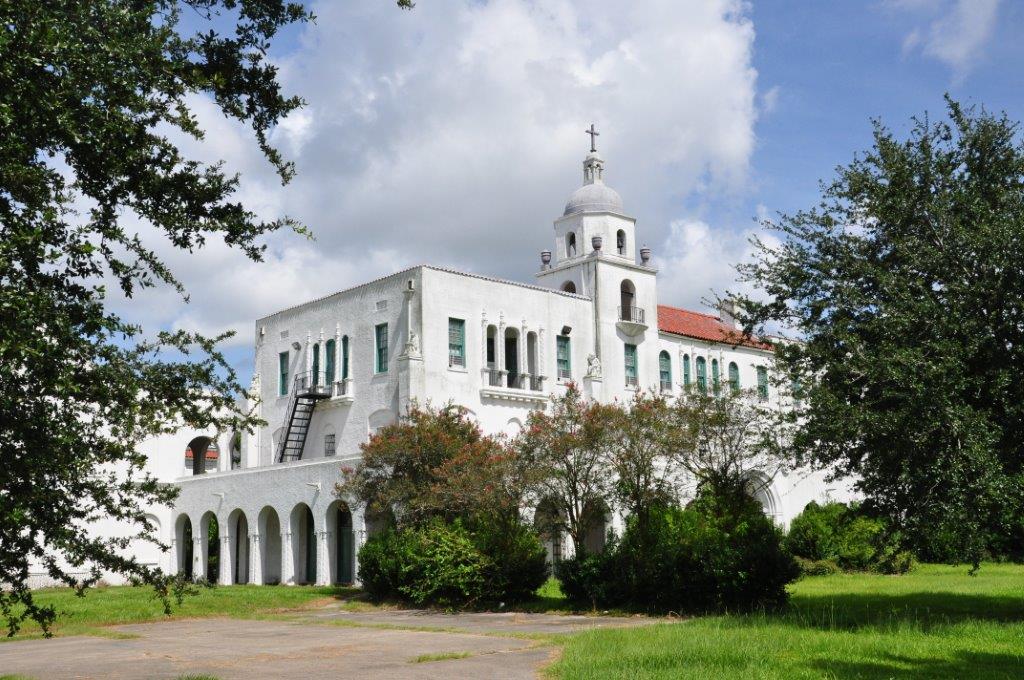
| Hope Haven |
The adventure began when we exited the Westbank Expressway in Marrero and turned on to Barataria Boulevard. Almost immediately, we were met with some of the most striking architecture in Jefferson Parish. Built in the 1920s and 30s, Hope Haven’s Spanish Colonial Revival-style buildings stand out amid this otherwise typical suburban area. From my Internet searches, it appears the impressive buildings house a school and a case management and family support center run by Catholic Charities, but they are grand enough to rival the Spanish missions found in Texas and California.
 |
| The water-filled, historic Town of Jean Lafitte |
Continuing south, we made a left on Leo Kerner Parkway and entered a long stretch of uninhabited highway. Both this route and Barataria Blvd. lead to Jean Lafitte National Historical Park and Preserve, one of our favorite spots to explore the swamps and a place I’ve written a lot about in the past. This weekend, however, we had a new destination, passing by the park’s entrance and ascending the high bridge over the Intracoastal Waterway. As the road descends, a pirate ship rocking on the high seas announces you’ve entered the historic town of Jean Lafitte.
We followed scenic Jean Lafitte Boulevard along Bayou Barataria, noting that the majority of the elevated houses here seem to be permanent homes to the town’s residents rather than secondary fishing camps. Our first stop was the new Lafitte’s Barataria Museum and Wetland Trace, which celebrated its grand opening on Saturday. A large tent out front indicated the celebration, and the kids were shouting “balloons!” before we left the car. While they ransacked the kids’ table, gathering up stickers, coloring books, pirate bandanas and tattoos, Paul and I eyed the free tastings of alligator-stuffed mushrooms and crab cakes. In hopes of relaxing and enjoying the live Cajun music, we set up our folding chairs in front of Bruce Daigrepont and his band, yet the kids had sat long enough in the car and were not remotely interested in relaxation.
.jpg) |
| Lafitte’s Barataria Museum |
So we herded them into the museum, where a half hour movie introduced us to the town’s history and that of its residents. Beautiful aerial shots showed the village surrounded by its lifeblood of water, swamp and marsh, and one resident drove the message home by saying he never knew there was solid land until he was taken to the French Quarter when he was 14. The town itself takes its name from the notorious pirate Jean Lafitte, who used the mysterious swamps to hide his smuggling operations. Today’s residents aren’t quite as scandalous, yet those we met were perhaps just as entertaining and lively.
The museum, although small, is packed with intriguing items from the area, from an entire display of the animals found here to a gun used by one of Lafitte’s pirates during the Battle of New Orleans. Although 2-year-old August buried his face when confronted with the talking alligator, the other children present got a kick out the reptile. Unfortunately, two among us didn’t have the patience for the oral history presentations, so we skipped that section to instead head out back to the Wetland Trace.
 |
| Alligator along the Wetland Trace |
Nearly a mile long, this boardwalk trail through the swamp caught our 5-year-old’s attention like nothing else that day. We spent an hour and half stalking snakes and lizards, pointing out alligators to others passing by and trying to determine what and where all that clicking noise was (our best guesses were baby birds in the rookery or click beetles taunting us from the trees). Although the lines were too long for us to join the swamp tour leaving the docks off the back of the boardwalk, the entire mission was still a success as we saw five snakes of varying sizes and colors, countless water turtles and one very close alligator. Plus, now we have something more to go back for next time.
 |
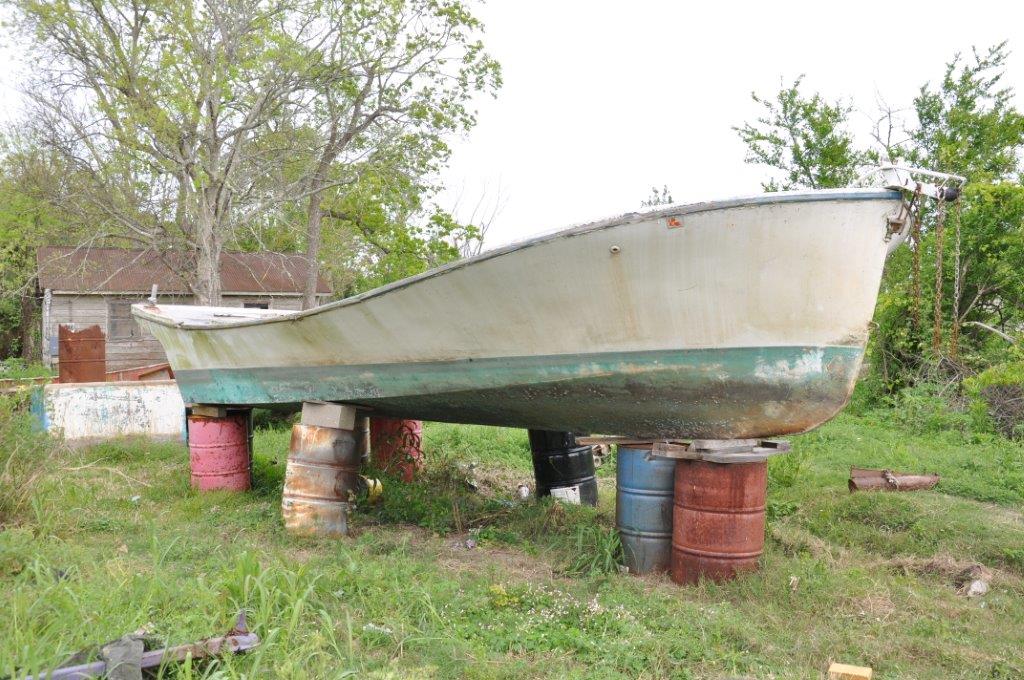
| Boat ready for a new paint job |
Back in the car, Charles begged to continue down the road as he wasn’t ready to go home yet, so we kept driving to see what else we could find. On our way to the museum, we had passed an old plantation, still standing but fighting a losing battle with the elements and weeds threatening to suck it back into the earth. Now, on our left, an old boat was lifted on barrels, preparing for an overhaul from its owner.
At the museum, we had learned that Lafitte is home to 11 cemeteries. Fleming Cemetery, notable for its white-washed tombs on top of an Indian mound, is privately owned and inaccessible to the public, yet can be seen from the water and is a highlight of area boat tours. Another, Lafitte Cemetery, is said to be the burial grounds of Pirate Jean Lafitte himself. This was our last photo op before the main road branched off into smaller outlets and essentially ended at a busy boat ramp bustling with fishermen.
 |
| Legend says this is the burial grounds of Pirate Jean Lafitte |

by admin | Mar 19, 2013 | Greater New Orleans
Nearly two years ago, we drove the San Bernardo Scenic Byway through St. Bernard Parish, headed for the Chalmette Battlefield and the Los Islenos Fiesta. This weekend we returned to hit a few spots we had missed on our initial journey, starting with Old Arabi and finishing in Shell Beach where another Louisiana roadway abruptly ends at a large body of water.
 |
| Old courthouse and jail in Arabi |
As soon as you cross into St. Bernard Parish, you reach the Old Arabi Historic District. A quick drive up and down the roads leads past a number of historic sites, such as the “Andy Griffith-style” jail built in 1911. The beautifully designed Maumus Center, St. Bernard’s first high school that later served as a community center, was gutted and undergoing a massive overhaul that would undoubtedly return this building to its previous splendor.
 |
| LeBeau Plantation |
One of the most fascinating landmarks in Old Arabi is LeBeau Plantation, an 1854 mansion boarded up and presiding over a large open field. The very sight of it conjures up ideas of ghost stories and tales untold. Down the street, however, the Greek Revival Cavaroc House appears in pristine condition at the end of a row of majestic palm trees. The two homes can’t be more different, though. While one stands in near ruin yet proudly displayed for photographs, the other is a bright gem next to the industrialized Domino Sugar Refinery yet tightly guarded against any would-be sightseers. In fact, try to take a picture of this mansion, and you’ll be tracked down, instructed to delete all your photos and have your license plate number recorded. I’m talking hyper-security.
So we carried on, following the scenic byway past the Chalmette National Historic Park and National Cemetery and under a lane of live oaks known as the Dockville Oaks. When the main road split and headed east, we turned right and continued alongside the Mississippi River to St. Bernard State Park. Letting the kids run out some energy, we started with a short nature trail linking the picnic area to the swimming pool, a top attraction during the hot summer months. Luckily, they were in the mood to run because one pause and the mosquitoes attacked. We escaped quickly and found safety in the open picnic area, where we ate our PB&J sandwiches next to a very curious lizard. Halfway through the gourmet meal, the kids spotted the playground and went off to climb, jump and make sand castles–in between sneaking around poles to “spy” on the girls celebrating a birthday party.
 |
| The Old Courthouse near the Los Islenos Fiesta |
It was a nice break before climbing back in the car and backtracking our way to the byway again. We soon approached the Old Courthouse, an impressive building for any city, but even more so being located in the largely rural section of the parish. Just past the courthouse, a long line of people and the flickering lights of carnival rides alerted us that we had once again visited during the Los Islenos Fiesta. We were tempted to stop but chose to continue on to our destination of Shell Beach, the tiny fishing community we had not reached previously because the road was closed. Alas, a few minutes later and we discovered that the road was still closed two years later. This time, however, we were not so easily thwarted, and instead turned the car around and returned west until we found a crossover to Highway 46, a parallel route to the byway.
 |
| Katrina Memorial |
The highway bypassed the small towns and provided a quicker route to Florissant Highway, the far-reaching road to Shell Beach and Hopedale. Ruins of homes, vehicles and bare, dead trees stood as hurricane casualties, leaving the eerie impression that we were approaching nothing more than an abandoned village. And then the scenery changed and a waterway stacked with colorful boats led to a thriving, vibrant community. Pelicans guided the last few miles of our drive until we parked in front a memorial dedicated to those who died during Hurricane Katrina. A large cross bearing the face of Jesus was rooted in the waters before us, and a plaque listed the names of the St. Bernard residents who passed.
Climbing out of the car, I mistakenly thought ash was falling from the sky around me. It only took a moment to realize it was a flurry of biting gnats. A family, with every inch of their bodies covered with clothing, was fishing and crabbing here, and the birds sat patiently awaiting their next catch. In the distance, the remains of a large fort was oddly out of place floating above a sea of marsh grass. While I swatted the bugs, the kids seemed oblivious, instead chasing birds and collecting oyster shells before we gave up and retreated to the car.
 |
| Crabber protected from the gnats |
Our final stop was Sebastopol Plantation, a place we had fond memories of from our previous visit. We passed through the gate thinking we would soon see owner Alberta Lewis, who would gladly let the boys marvel at the chicken coop. Instead, we found her son, who broke the news that his mother had passed away. However, he was just as eager to let us roam the property. Since our last visit, and before Alberta had died, she had acquired a set of turkeys to add to her collection of chickens, roosters and peacocks. Much larger than I expected, the male turkey strutted and shimmied all around us, preparing for a showdown with our four-year-old, who was only slightly taller than the bird. It was the perfect ending to our day’s adventures and left us with much to talk about later.
 |
| Sebastopol’s turkey |

by admin | Mar 5, 2013 | River Road
It’s a rare event that we have an adults-only weekend, but acknowledging the antiques and information-filled tours at many River Road plantations, we reserved our trip there for just such a time. We started late on Saturday (after soccer, of course), dropped the kids at their grandparents and headed out I-10 toward Sorrento.
 |
| Laura Plantation |
First up was dinner at The Cabin Restaurant, an original slave cabin from Monroe Plantation. Newspaper still plastered the inside, once used to insulate the former home. Filled with old farming equipment, our back dining room was built to look like a garçonnière, where bachelors stayed on a plantation. The food was hearty and low-key, with the chicken and sausage gumbo coming as a top recommendation from our waitress. There appeared to be a collection of old buildings in the courtyard–slave cabins, a general store and the first Catholic school established for children of color, but unfortunately it was too dark to look around.
 |
| Bocage Plantation |
Our destination for the evening was Bocage Plantation, a masterfully restored plantation home built in 1837 on land once owned by a descendant of Christopher Columbus. Now open as a bed and breakfast, the four-bedroom mansion offers guests the ultimate in luxury. Our host greeted us with a tour of our room, the first-floor Venetian Room decorated with rich colors, an inlaid ivory bed and antiques we’ve only seen in the finest of homes. With a glass of wine in hand, we spent the evening in good conversation with our fellow guests–a doctor from Houston, an engineer from Baton Rouge and our gracious manager and tour guide Roberto.
 |
| In the garden outside Bocage Plantation |
We awoke to the smell of bacon (yum!) and marveled at the walk-in steam shower that fought for our attention against the elaborate breakfast waiting for us in the dining room. Our master chef Igor, a native from Ukraine, whipped up omelets, biscuits and apple pancakes all served on fine china alongside our fruit-filled crystal bowls and espresso. Although he spoke little English, he told us of his love of black and white photos, so the pictures featured in this blog are converted in his honor.
The morning was chilly outside, but we bundled up and walked the grounds for better views of the mansion. Horses grazed in the fields next to us and ruins lay in the back of the property from when sugar cane used to be harvested and burned on the property. We said our goodbyes and pointed the car toward the Sunshine Bridge, crossing the Mississippi River and carrying on to the other side.
 |
| American Queen Steamboat |
Traveling south, we were struck by the sight of a steamboat docked along the river’s bank. We quickly pulled over and climbed the levee to get a better view of the American Queen, stopped in Vacherie on its voyage from New Orleans to Memphis. Turning around, we smiled at the familiar row of 300-year-old live oaks lining the path to Oak Alley Plantation, probably one of the most photographed places in the country. We only had a minute to take in the view, though, before we continued on to make our tour at Laura Plantation.
 |
| Slave cabin at Laura Plantation |
The elevated and brightly colored Laura Plantation home stands as a tribute to the generations of Creoles and their slaves who once lived on this property. In one of the most captivating Louisiana accents I’ve ever heard, Stephen, our tour guide, led us through the history of Laura Locoul’s family. The tour is based on Laura’s memoirs and spares no details in describing the lives of her ancestors, from their business successes to their personal sacrifices, from the raw, but generally accepted treatment of slaves to the family’s own downfalls. It’s a thought-provoking tour–one that will stay with me for quite some time.
Unfortunately, there is only so much time in a weekend, and the rest of River Road’s grand plantations had to be saved for another day and another adventure.
 |
| Oak Alley Plantation |



.jpg)