by admin | Mar 14, 2012 | Greater New Orleans
Beyond Lake Pontchartrain and Covington, out past sprawling plant nurseries, lies the Global Wildlife Center in Folsom. We made the trek to the far reaches of the Northshore to see the more than 4,000 exotic animals that reside here at this 900-acre wildlife preserve.
 |
| Wagon tour of the Center |
As we drove alongside the property, our anticipation grew as we saw the animals frolicking in the fields before us. When our car turned in the main gate and crossed over the cattle guard, Charles thrust my iphone back into my hands to focus his full attention out the window. Dozens of wild animals walked slowly by, creatures we’d never seen before – not even in storybooks.
We approached the Visitor’s Center, thinking we’d buy tickets for the 1 p.m. tour and eat our PB&J sandwiches by the koi pond while we waited. It turned out the noon tour leaves at a quarter after, though, so we dragged the kids out of the gift shop and boarded the last in a string of covered wagons. Thinking we were on a train, Charles bounced about shouting “All Aboard!” while August clung to me in fear of all the new people around him.
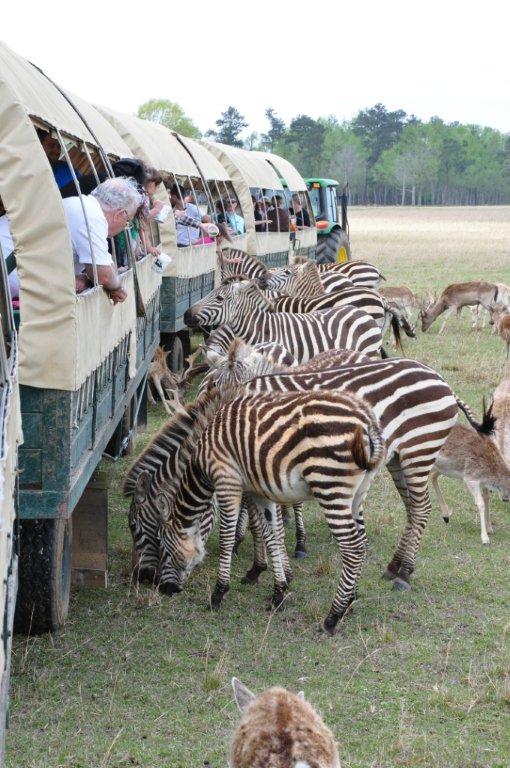
As the “train” lurched forward, though, and we entered the animals’ realm, they both were overcome with pure and utter joy. Armed with our bucket of feed, we were shoveling cups of food into the animals’ mouths, while August was literally squealing with delight. If I hadn’t held him back, I’m almost positive the child would have jumped right in the middle of those four-legged grazers.
 |
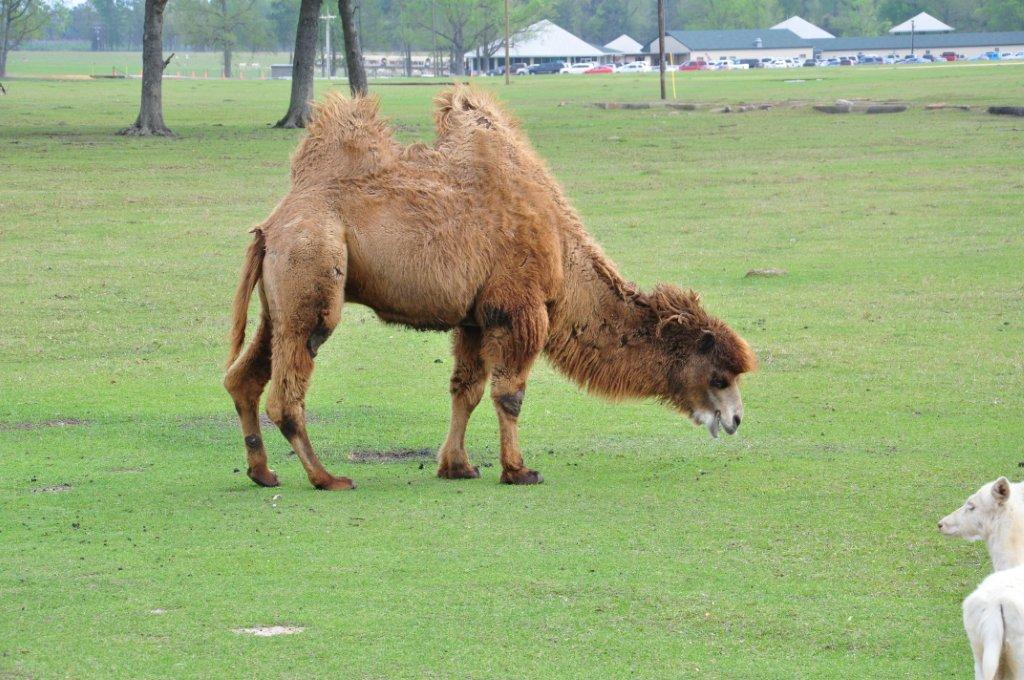
| Bactrian Camel |
The numbers were astonishing, and the varieties of colors and types purely amazing. From the African kudus with their spiraled antlers and the two-humped bactrian camels to the ostrich-like rheas and the frisky pere david deer, we fed, pet and giggled at them all. While the giraffes were standoffish, the zebras were overjoyed with us and begged for our attention. The gentle llamas ate feed right out of my hand, while other animals ran away with the cups they were supposed to be eating out of.
A strong wind blew throughout the thrilling ride, and by the last ten minutes of the hour and a half tour, the boys were (for once in their lives) exhausted. That in itself is a rare feat to accomplish. We topped the trip off by feeding the giant koi and catfish living in the picnic area’s pond while scarfing down our sandwiches.
 |
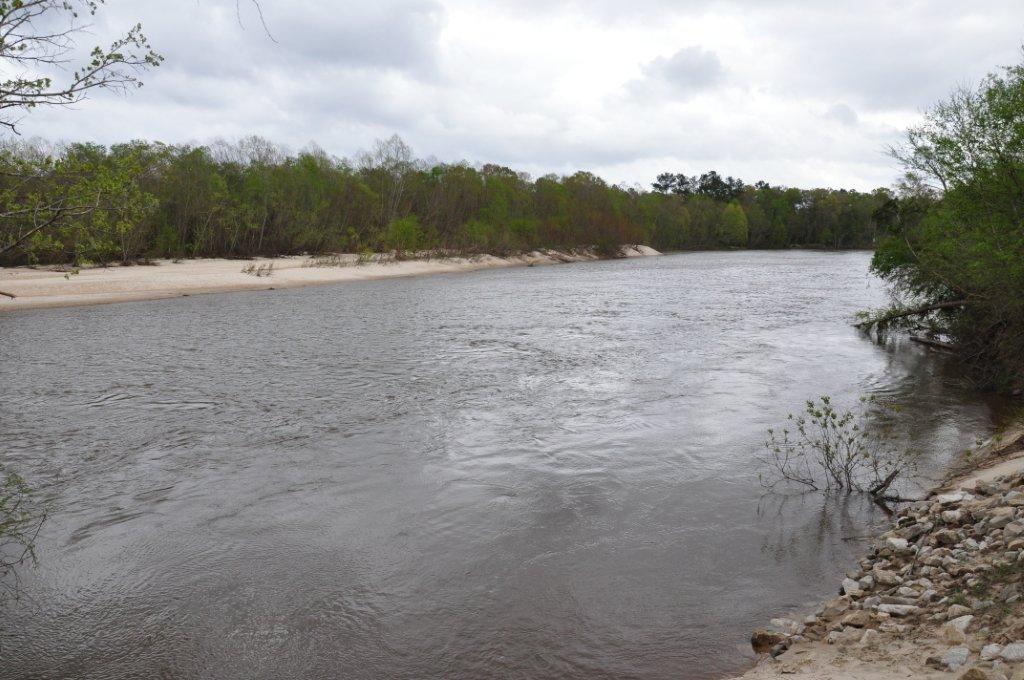
| Bogue Chitto River |
It was a successful day, and we drove away with full intentions to head back home in triumph. But Charles gave his best puppy-dog look, and with his newly purchased elephant in hand, pleaded for us to continue the adventure. Paul and I are both suckers for that, and after a quick glance at the map, decided to swing past the state’s newest state park – Bogue Chitto. We drove the park’s loop, taking in the scenic views of the gorge and the Bogue Chitto River while letting the car’s movements lull August through an afternoon nap.
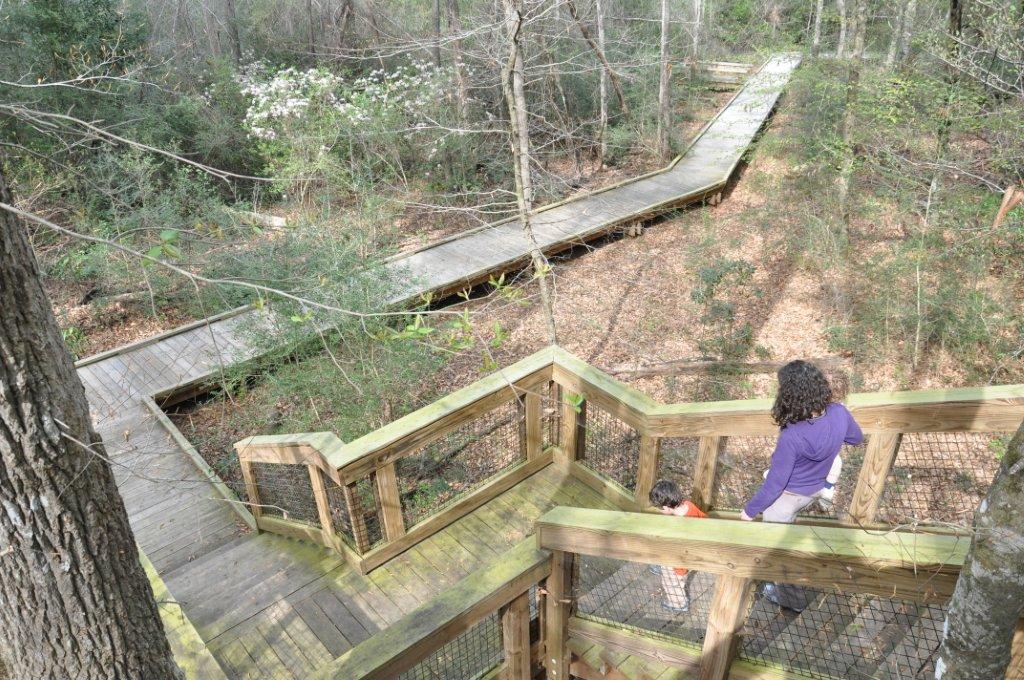
As we turned the last curve to exit the park, the toddler awakened and we used the opportunity to hike the gorge trail that had been beckoning to us since we first saw it. A path of leaves and pine needles led the way through the woods to stairs leading deep within the gorge. At the bottom, a boardwalk snaked around through a much wetter landscape, and lizards fled our every step. With lightning speed, Charles actually caught one and vowed to never let it go. Fortunately, the animal was resourceful and squirmed his way free. As the tears came rushing down, we decided the outing was over, and headed home to recoup and plan for the next adventure.
 |
| Stairway into the state park’s gorge |

by admin | Feb 29, 2012 | Alabama, Beyond the State
A short road trip out of state landed us in Alabama’s Dauphin Island, a barrier island at the mouth of Mobile Bay. Vacation hotspot for locals more so than tourists, you won’t find any shopping outlets or putt putt golf here, but rather quiet neighborhoods overlooking the bay and expansive, white-sand beaches. Unless, of course, you visit during the Alabama Deep Sea Fishing Rodeo, the largest fishing tournament in the world.
 |
| Dauphin Island’s Bird Sanctuary |
 |
| The island’s residential side |
Lucky enough to have family to stay with on the island, we arrived late in the evening to put us in reach of an early morning beach walk. We were the only car parked at the public beach, and a cold breeze followed us as we walked along barefoot across the ultra-fine sand toward the Gulf’s lapping waves. I remember years ago watching the waters beneath the fishing pier and elevated picnic areas. Today, more sand has drifted to the west end of the island, making the beach wider than ever and the pier jut out over a sea of sand.
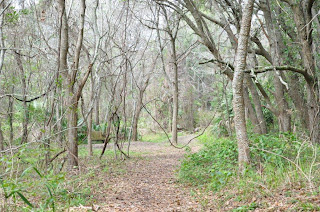 |
| Trails through Shell Mound Park |
I gathered small seashells while Charles chased the seagulls and Paul photographed the rather large mounds of what appeared to be jellyfish. We were able to enjoy the views for half an hour before August began whimpering in the cold, and we sought shelter in a more contained part of the island. Shell Mound Park marks the site of prehistoric mounds built by early Native Americans. Today, only a few oyster shells poking up through the path belie that this hilly nature walk is an important archaeological site.
With hiking on our mind, we ventured farther down the island to the Audubon Bird Sanctuary. Miles of walking trails cut across 164 acres of land protecting one of the best places in the country to view migrating birds. A boardwalk leads past pines and live oaks to an overlook at Galliard Lake. Continuing on, you eventually emerge back at the beach’s sand dunes.
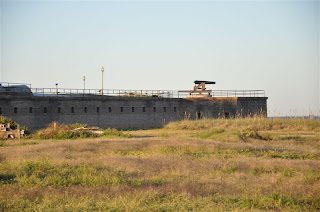 |
| Historic Fort Gaines |
On the far east side of the 14-mile-long island stands Fort Gaines, built in 1821 and integral in the Battle of New Orleans, the fort is famous for Admiral Farragut’s command “Damn the torpedoes – full speed ahead!” It’s a well-preserved fortification and reenactments are held here throughout the year. Other highlights of the east side are the Estuarium at the Dauphin Island Sea Lab and a ferry across the Bay to Historic Fort Morgan. There’s never enough time to discover it all, though, and our weekend ended all too quickly.

by admin | Feb 13, 2012 | Featured Posts, Greater New Orleans
Bundled in puffy jackets and hoods, we fought the weekend’s blustery weather and – in between Mardi Gras parades – carved out some time to discover another of Southeast Louisiana’s (SELA) eight National Wildlife Refuges. Encompassing nearly 19,000 acres of Lake Pontchartrain’s north shore, Big Branch Marsh NWR is another one of those remote gems, completely hidden within plain site of 1.2 million people.
Because of its close proximity to Big Branch Marsh, we began our journey at the Visitor Center for all eight of the SELA refuges. Just north of where Highways 434 and 190 intersect in Lacombe, this impressive complex was far beyond our expectations. A former Redemptorist seminary, the vast property retains the feel of a religious retreat with contemplative trails winding through sasanquas and camellias past a grotto, Bayou Lacombe and a cemetery for Redemptorist priests.
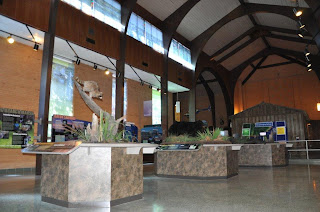 |
| SELA Refuges Visitor’s Center |
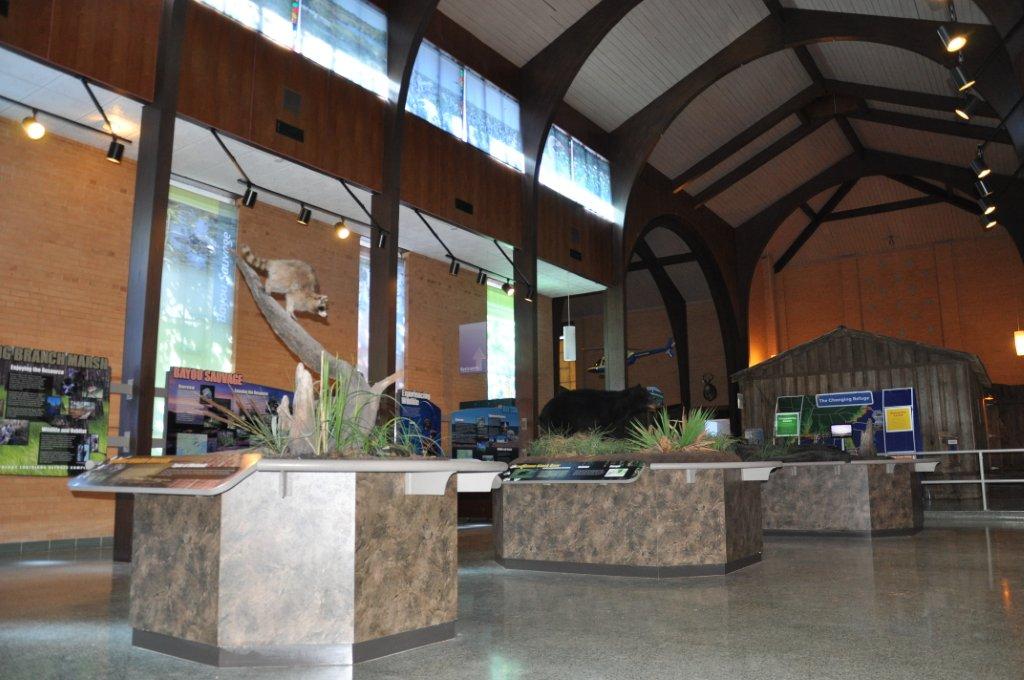
Stepping inside the Visitor’s Center, we instantly realized this cross-shaped building with vaulted ceilings was the former chapel. The U.S. Fish and Wildlife Service had done an amazing job turning the space into a natural science museum, complete with displays highlighting the eight refuges, preserved animals, a video and an interactive cabin. The kids gawked at the black bear and alligator before scaling the ramp to the intriguing shack. Inside, a dark room hid various Louisiana wildlife. I handed Charles an available flashlight and watched with delight as he discovered owls, snakes, turtles, deer and a bobcat. Every time his light landed on one of the lifelike eyes, it triggered the hoots and growls of the featured animal.
 |
| One of the many camellias along the Camellia Trail |
Outside, we followed the grotto and camellia trails past hundreds of blooming camellias, losing count as to the number of varieties of pinks, reds, whites, striped and polk-a-dot flowers. As Paul paused to read the names of the priests buried in the cemetery, the kids and I traveled the final camellia lane where we discovered the find of the century – at least to a three-year-old. A two-foot snakeskin completely intact appeared to be slithering across the path. It now holds a place on his dresser next to his cicada shells and caterpillar cocoon that hopefully will soon become a monarch butterfly.
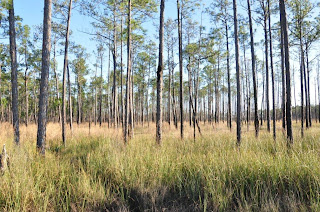 |
| The pine forest of Big Branch Marsh NWR |
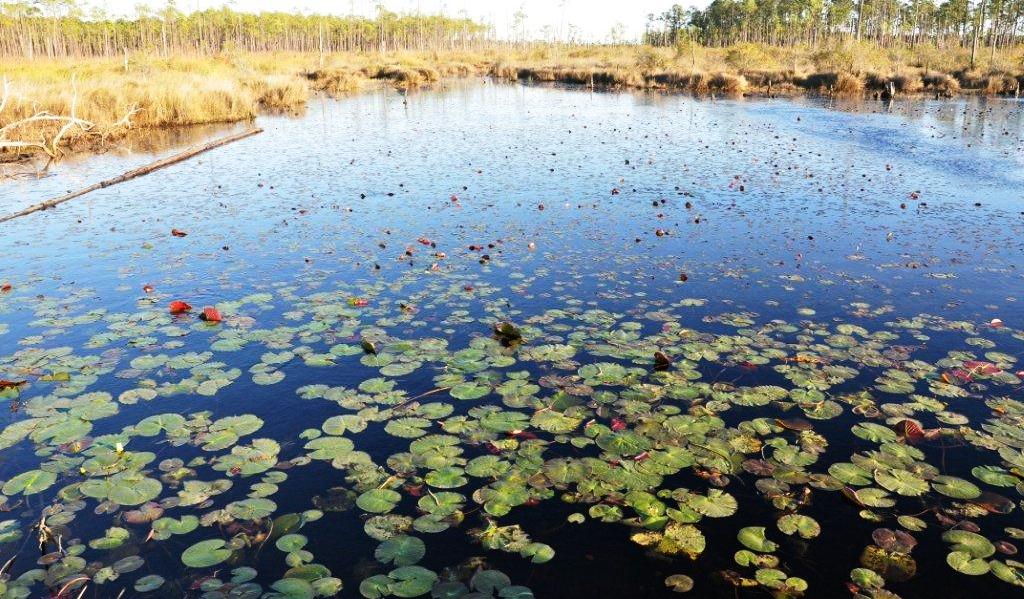
The sun was well on its way in its descent into the horizon, so we hurried back along Highway 190 to the Big Branch Marsh boardwalk and nature trail. A half-mile, self-guided tour immersed us into pine flatwoods that opened up to a lilly pad covered freshwater marsh. The wind was brutal in the open area, at one point launching an empty stroller into the water, but the serene views of saw grass and birds were well worth our endeavors. However, at the end of the boardwalk, we followed the limestone trail back to our car rather than continue along the 4-mile roundtrip Boy Scout Road Tour.

by admin | Feb 1, 2012 | Cajun Country, Greater Baton Rouge
Louisiana is not known for dinosaurs – that much I have learned through my Internet searching. Now Wyoming, Colorado and the Dakotas, they’re a different story. Unfortunately the pleads of a three-year-old are not compelling enough to make me drive 26 hours to view a bunch of skeletons. Lucky for him, and the rest of our family, the Lafayette Science Museum is featuring the American Museum of Natural History’s traveling “Dinosaurs” exhibit.
 |
| T-Rex on display at the Lafayette Science Museum |
The drive is still a bit much to make without stopping, so we planned a layover at a friend’s house in Baton Rouge. While in town, we couldn’t pass up a glimpse of LSU’s Mike the Tiger, and the trip to campus reminded us of old anthropology classes in the Howe Russell building and the fossils and rocks on display there.
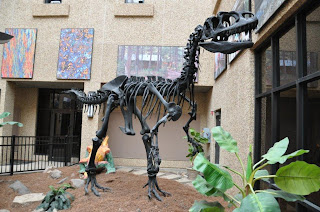 |
| LSU’s allosaurus skeleton |
It promised to be a great “starting off” site for our dinosaur adventures, but when we entered the front doors, Charles nearly squealed with delight at the sight before us. Although the child can’t read, he instantly spouted out that this skeleton on display was “an allosaurus – a carnivore that walked on two feet and had three fingers, not two like T-Rex.” (I must say, I will never understand his obsession with the fingers.) The discovery kept us occupied for quite some time, and Charles discussed the similarities and differences of dinosaurs in lengthy detail well into the night.
The next morning we moved on to Lafayette and headed into the heart of downtown. Our first stop was brunch at The French Press, where we gorged ourselves on the Cajun Benedict: toasted French bread, Hebert’s boudin and two poached-medium eggs topped with chicken and andouille gumbo and fresh scallions. Shortly after, we waddled across the Parc Sans Souci toward the Lafayette Science Museum.
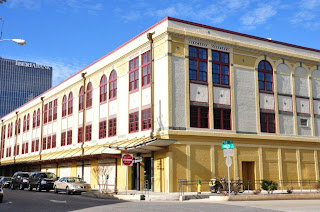 |
| Lafayette Science Museum |
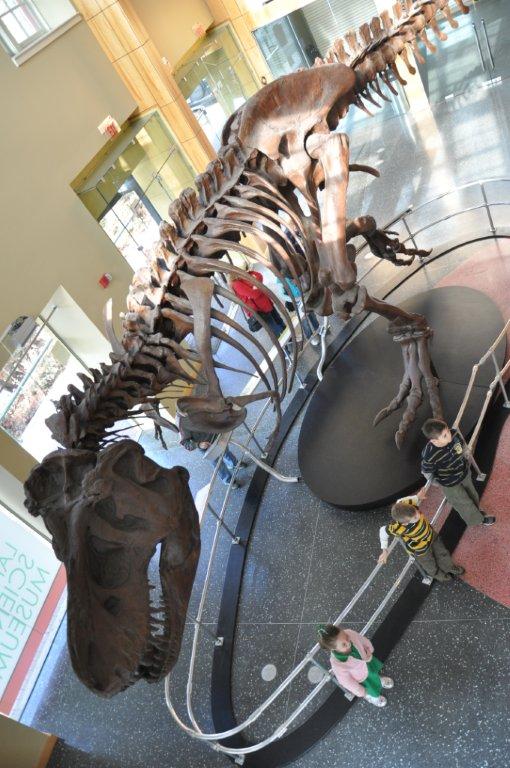
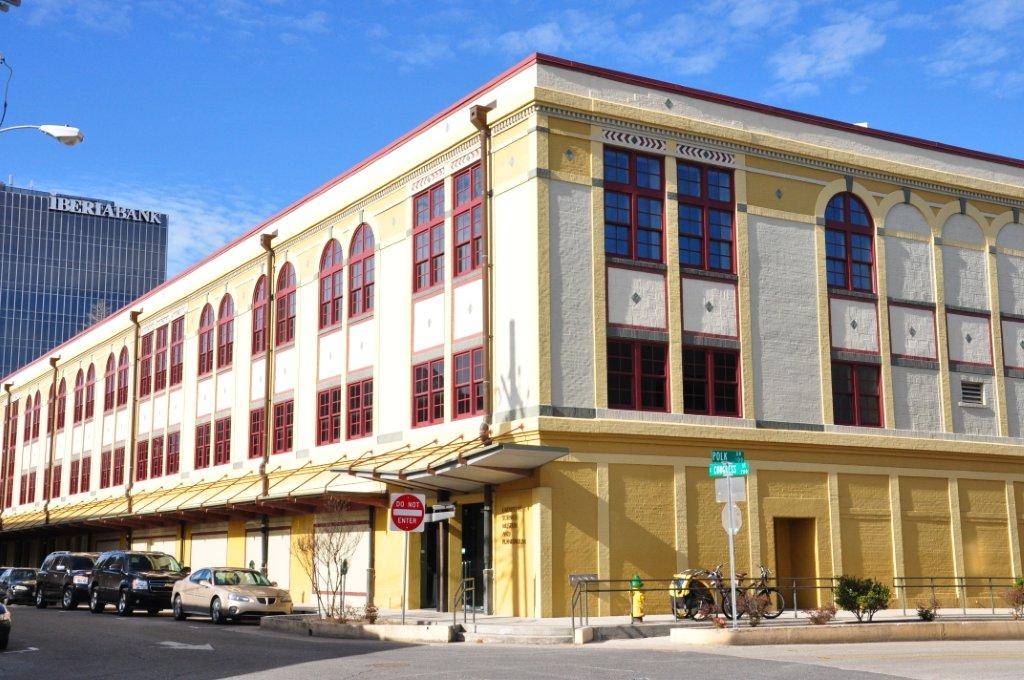
While the planetarium is closed for a digital upgrade, the main attraction until March 11 is the “Dinosaurs: Ancient Fossils, New Discoveries” exhibit. The $5 tickets seemed like a bargain when we entered the far hall and came face to face with a giant T-Rex skeleton (complete with two fingers on each hand). He beckoned us inside to explore a life-sized steel and fiberglass apatosaurus, fossilized footprints and a diorama of eastern Asia as it looked 130 million years ago. After making two rounds through the displays, we grabbed some coloring sheets at the end and walked out the doors. I paused in confusion as we exited – what, no gift shop? Although a huge missed opportunity for the museum, it was a lifesaver for us, as gift shops almost always end in meltdowns.
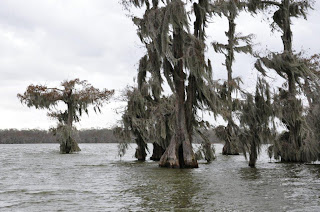 |
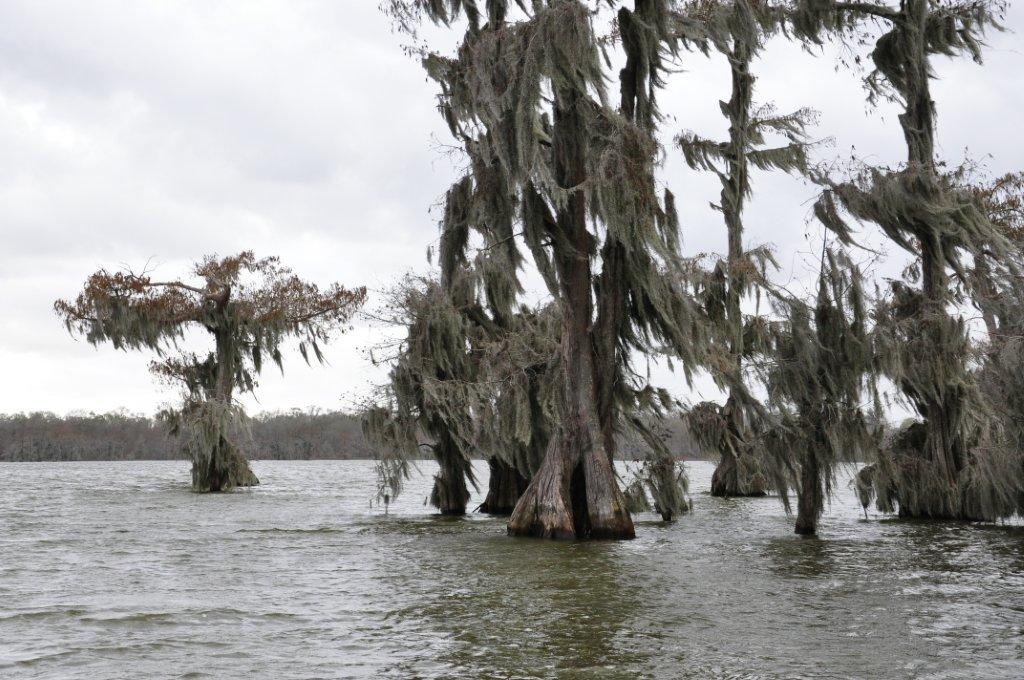
| Cypress trees at Lake Martin |
The afternoon’s adventures winded down with a short drive out into the countryside and a leisurely stroll through the Nature Conservancy’s Cypress Island Preserve at Lake Martin. A loop boardwalk and levee trail offered prime glimpses into the moss-covered, cypress tupelo swamp that serves as a bird haven in late spring. Sunsets are reportedly divine at this picturesque spot, and the lake comes to life when thousands of herons, egrets and roseate spoonbills make this their home during nesting season. The area was scarcely occupied when we visited, though, and I left with the impression that we had found a jewel tucked away inside the state.

by admin | Jan 25, 2012 | Greater New Orleans
Beyond a line of Vietnamese stores and restaurants, Chef Menteur Highway journeys to the far edges of New Orleans, deep into the nation’s largest urban National Wildlife Refuge. Just a short distance from our house,
Bayou Sauvage NWR is a flashback to what much of this area used to look like – or perhaps more of what the natural landscape has become.
 |
| Fort Pike on The Rigolets Pass |
|
 |
| Bayou Sauvage National Wildlife Refuge |
As we took our time unfolding strollers and loading in kids and snacks, a rush of cars filed into the previously empty parking lot. Almost on cue, doors flew open and members of the Slidell Hiking Club emerged. While they milled around the display of posters describing the refuge, we scooted down the boardwalk out of sight.
There was no water standing under the wooden walkway, and 3-year-old Charles seemed thoroughly confused as to why we couldn’t walk on the ground. We distracted him from his interrogation with a challenge to race. The end of the 2/3 mile trail came sooner than expected, and we unbuckled August and let him stretch his legs while we took in the expansive landscape in front of us.
The entire route had been enveloped with short vegetation and an occasional live oak. Here, at the end, though, short cypress knees and stubby tree trunks were all that remained from the saltwater damaged and logged forest. The landscape was strangely barren at first glance, but when we looked deeper, there were signs of life everywhere. Far in the distance, an island of live oak trees towered over the flat land, marking the spot where Tchefuncte Indians once built ancient shell middens.
 |
| Abandoned Fort Macomb |
As the Slidell hikers approached, we finished off the loop and continued out Chef Menteur toward Fort Pike State Historic Site, pausing first to snap a few pictures of the abandoned 19th century Fort Macomb along the shores of Chef Menteur Pass. Overgrown and crumbling into the waters surrounding it, Fort Macomb appeared to be the forgotten stepchild of the two forts designed to protect Lake Pontchartrain. On the other hand, Fort Pike, which once guarded The Rigolets (French for “Little Ditch”) pass to the lake, was staffed and open for viewing – and for shooting movies apparently. When we arrived this past weekend, the fort was still recovering from serving as the background for “G.I. Joe 2.”
 |
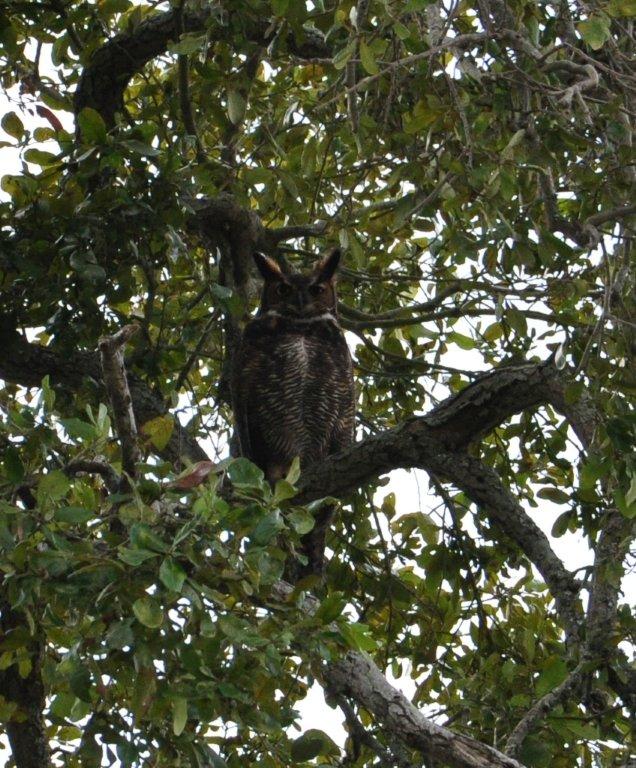
| Great Horned Owl |
While August and I paid the modest $4 entry fee, Paul and Charles began investigating the feathers and other bird parts littering the ground around a large oak tree. One quick glance up, and they were astonished to see a two-foot-tall great horned owl glaring down at them. He’s a permanent fixture in the tree, and as we learned from the park guide, his mate spends her days under the nearby bridge. They meet up at night to hunt and eat.
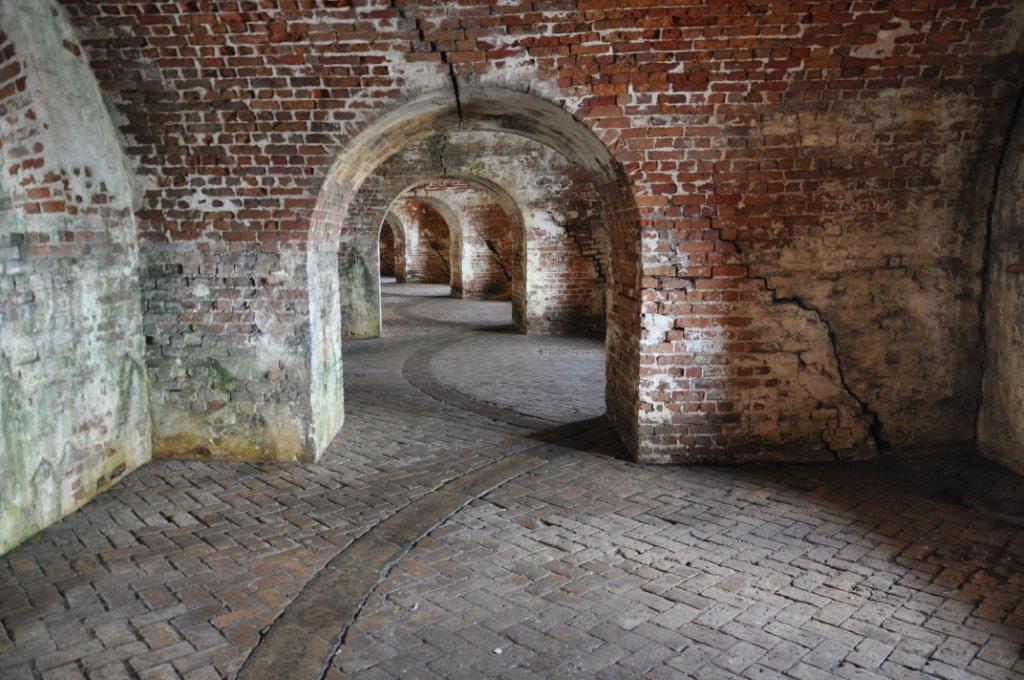
Across the moat, we entered the cool, brick arches of Fort Pike. Completed in 1828, the fort served in various capacities in the Seminole Wars, the Mexican War and the Civil War. Although aged from time and the elements, the fort was largely intact, complete with the interior citadel stronghold. Rooms are marked to denote their original purpose, such as a bakery, general store and officers’ quarters, and strategically placed cannons look out over the waters beyond. I pushed the stroller up the rooftop ramp, and we carefully made our way around the top of the fortress, watching the pelicans gracefully fly past. I easily imagined myself transported back in time to live here on this serene site, and then I shuddered to realize the soldiers and their bustling activity that would have been happening all around me.
 |
| Inside Fort Pike |