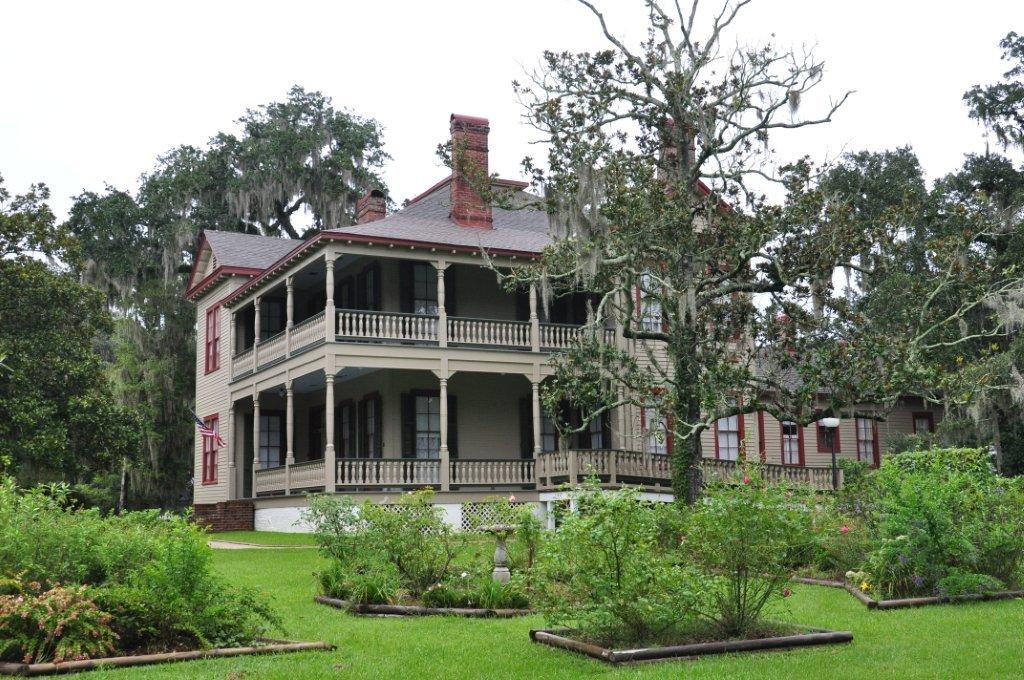
by admin | Nov 27, 2012 | Alabama, Beyond the State
Growing up in Alabama, a Thanksgiving family tradition was to visit the Poarch Band of Creek Indians in Atmore, Ala., for their annual Pow Wow. This year, we continued the tradition by bringing our children to see the colorful costume displays, rhythmic dancing and Native American crafts.
.JPG) |
| Dancers compete at the Pow Wow |
As the only federally recognized Indian tribe in Alabama, the Poarch Creek Indians trace their roots back to the original Creek Nation found throughout Alabama and Georgia. Today, the Indians live in a mostly rural reservation, dotted with sprawling cotton and corn fields and supplemented by a towering casino.
Although we arrived before lunch, the parking lot was nearly filled to capacity. A shuttle whisked us from our cars to the front entrance, where a small ticket booth marked the entrance to the large arena. The steady beat of drums signaled the location of the dancing competitions, and we climbed the bleachers to watch the men twirl and jump in their elaborately decorated and highly feathered outfits. The women, although much more subdued, showcased simpler yet exquisite costumes and a quiet graceful footwork.
While my nieces took time to pose with a few Native Americans, we headed out in search of food. Roasted corn, buffalo burgers, Indian tacos and fry bread were just a few of the options, and, of course, we tried them all.
.JPG) |
| Jumping high |
I was amazed at how long the kids had lasted before darting over to the children’s area. They marveled and pointed at the bounce house maze and the bigger kids spinning and jumping in various stomach-turning machines. While their cousins braved the bungee cord jumper, demonstrating their mad flipping skills, my two settled on the pony ride–or at least looked at the ponies before deciding they were still a bit too scary.
Just then, a child walked by with a bow and arrow, and all thoughts of rides were immediately over. A double row of booths lined the outer edges of the festival, and we steadily made our way past one after another. The souvenirs and crafts were nearly overwhelming, as each booth offered beautiful displays of dreamcatchers, animal-print shirts, wooden toys and just about anything else imaginable.
.JPG) |
| Native crafts for sale |
Wooden alligator and pop gun in hand, we settled down for one more round of dancing before giving in to the yawns for nap time. A stop by a final booth on our way out landed us prized, buffalo-tooth necklaces, a lasting souvenir for mom and dad.

by admin | Nov 13, 2012 | Greater New Orleans
Although we’ve explored the trails at Jean Lafitte National Park’s Barataria Preserve dozens of times, every trip brings new discoveries. Sunday was the perfect day to visit, with mildly cool weather accented by rust-colored cypress trees and red maples (our version of fall colors).
.JPG) |
| Palmetto Trail |
With one sleeping babe and one rearing to go, we headed first for the Palmetto Trail, where quiet, long stretches of boardwalk suited everyone’s needs. The dark waters were peeking through lush, wild vegetation, pooling in small ponds under the shade of giant leaves. August napped to the rhythmic beat of the stroller wheels on wooden boards, while Charles filled his bug catcher with dried leaves and sticks, preparing a habitat for whatever unsuspecting bug he was sure to find.
For the most part, the trail was ours alone to embrace, the silence only broken a handful of times by mostly visitors with foreign accents. Aside from a few “pokey caterpillars” and elusive, croaking frogs, this initial hike was serene and uneventful–a grade A for us adults, but making our 4-year-old a little antsy at the unthinkable prospect of going home with an empty bug catcher.
.JPG) |
| Reflections in Bayou Coquille |
As we emerged from the giant palmettos and crossed the next parking lot, we once again entered the mysterious world of Louisiana’s swamps. Bayou Coquille was unusually clear of overgrowth and looked perfect for canoeing, and as the afternoon went on, the sky above the cypress trees became a fantastic blue.
We stopped several times to examine the spiders busily spinning their webs and looked forward to seeing the alligator we heard was lurking up ahead. As we stepped aside to allow some faster tourists to pass, Charles squealed with delight at spotting a giant, black lubber grasshopper waiting for him in the path. He impressed the passersby by fearlessly plucking the grasshopper from the ground and gently placing him in the prepared habitat.
.JPG) |
| Marsh Overlook |
It was enough to make this “the greatest day ever,” one that only got better when we finally spotted the 10-foot alligator lurking in the Lower Kenta Canal. He was well-hidden in this hyacinth-clogged canal, which looked so little like water that the kids thought they could walk right out on it.
Our leisurely stroll ended at the expansive marsh overlook. After a few relaxing moments of taking in the views, we strapped the kids in their strollers and starting sprinting back towards the Visitor’s Center. We had half an hour to cover the two miles back before the parking lot gates were closed at 5 p.m. Thankfully, the ranger was still waiting for us when we came huffing and puffing back to our car.
.JPG) |
| Parting views from the park |

by admin | Oct 9, 2012 | Cajun Country
More times than I can count, we’ve driven the I-10 between Baton Rouge and Lafayette as a straight-shot, watching the Atchafalaya swamps through our windshield tour. This weekend, though, we ventured off the Grosse Tete exit for what I thought was a small swamp exhibit at the Visitor’s Center. Instead, we discovered an amazing gem of a festival, with more free food and live music than we could ever imagine.
.JPG) |
| Live music at the Iberville Swamp Life Expo |
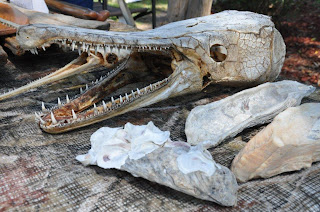 |
| Animals on display at the Iberville Swamp Life Expo |
We knew something was up when every road in the small town was lined with parked cars. The sounds of Cajun music filled the air as we walked the short distance from our car to the Iberville Swamp Life Expo. Shaded by live oaks and set alongside the peaceful Bayou Grosse Tete, the bustling event was in sharp contrast to the tranquil scenery.
A path of booths circled the property, and we began by browsing the largely functional art on display. Talented John James Clark’s rare display of hand-carved cypress boats looked too pristine for actual use, and artist Charlene Hebert’s oil paintings depicted life in the Atchafalaya. Naturally, the kids were drawn to animal skins and turtle shells on display, and my youngest even set up residence in an exhibitor’s folding chair – determined to just sit and people watch.
.JPG) |
| A big pot of jambalaya at the Expo |
And then came the food. We started off slow, with a piece of bread dipped in the wild flavor of homemade cane syrup. As we rounded the corner, I discovered the Cajun-made Bread Pudding and couldn’t resist its perfect consistency. I kept telling myself, “Life is short, so eat dessert first.” The next half hour was a whirlwind of Crawfish Etouffee d’Atchafalaya, Big Cajun Wild Duck and Andouille Gumbo, Big Pete’s Cajun Cracklins and Bayou Land Mustard Greens and Pig Tails.
We were all walking a bit slower when my four-year-old, Charles, spotted a whole alligator being carved up before our eyes. The still-warm meat melted in our mouths, and Charles was thrilled to shovel it in while boasting to anyone who would listen that he was a “carnivore.” The cooks must have been won over by him because they sent us home with a pair of alligator feet (skin still on), which my husband strategically “forgot” in a friend’s freezer.
.JPG) |
| Plantation in northern Iberville Parish |
After watching the crowd dance to the music for a bit, we continued on our journey, heading north toward Rosedale and Maringouin on a driving tour of historic homes. The Parish website offers a downloadable map marking the locations of several privately owned, but still exquisite plantations. We made the loop up 76 and down 77, passing fields of sugar cane and green pastures all lying on the outskirts of the Atchafalaya Basin levee.
It was a nice reprieve before jumping back on the interstate and soaring past this area’s untamed wilderness. Although we researched hikes in the Atchafalaya, particularly in the Sherburne Wildlife Management Area, the notice of hunting season made us shy away, and the kids were still too small for a canoe trip. Determined though to introduce them to the region, we opted for the next best choice, stopping at the University of Louisiana at Lafayette’s cypress swamp.
.JPG) |
| Resident of the cypress swamp at ULL |
Hidden behind a campus of buildings, the surprisingly large swamp presented more than we bargained for. Initially thrilled to spot a baby alligator among the abundant frogs and turtles, we became slightly nervous as a line of much larger alligators started following our movements around the lake. By the time we circled the entire area, we had seen more than a half dozen of the powerful animals. At one point, a student studying dropped his paper in the water, and I cringed as he reached over and lifted it out, half expecting a gator to get there first.
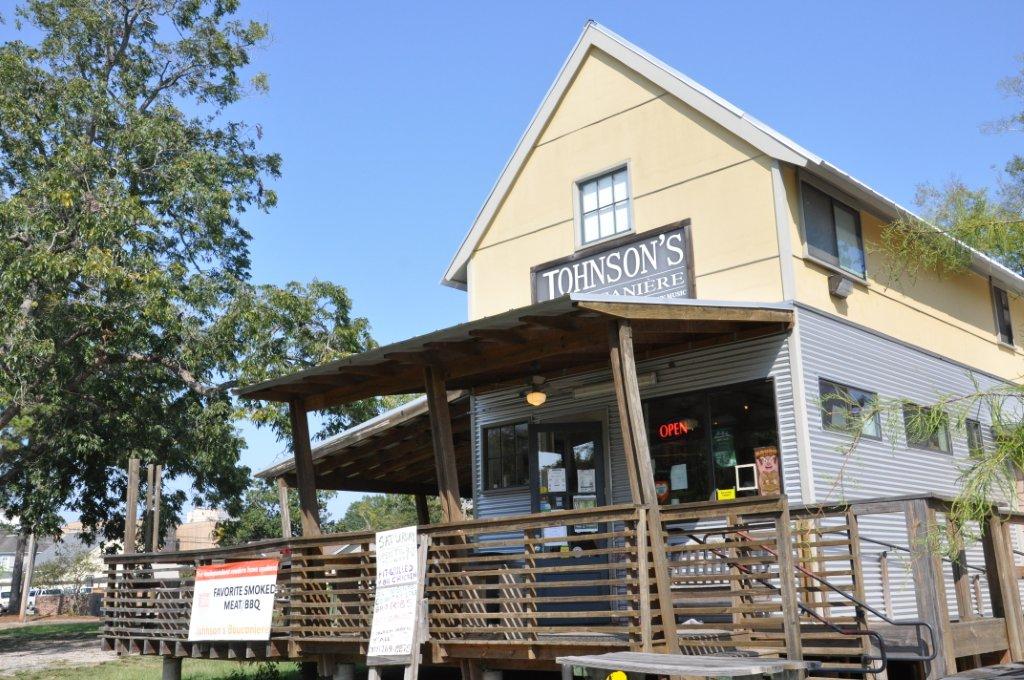
It was quite the experience, and of course, the kids were beyond excited by our day’s adventures. We finished strong with boudin grilled cheese sandwiches from Johnson’s Boucaniere in downtown Lafayette, before announcing that our diets started Monday.
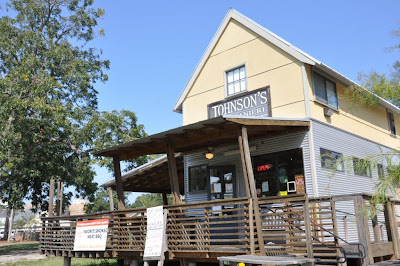 |
| Johnson’s Boucaniere in downtown Lafayette |

by admin | Sep 25, 2012 | Greater Baton Rouge
Saturday brought with it the first day of fall, and because you wouldn’t know it by the weather, we decided to celebrate by visiting the Harvest Days festival at Louisiana State University’s Rural Life Museum. For its 16th year running, the outdoor museum showcased a living history of 19th century rural Louisiana, and we spent the day walking through their fascinating lifestyle.
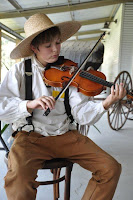 |
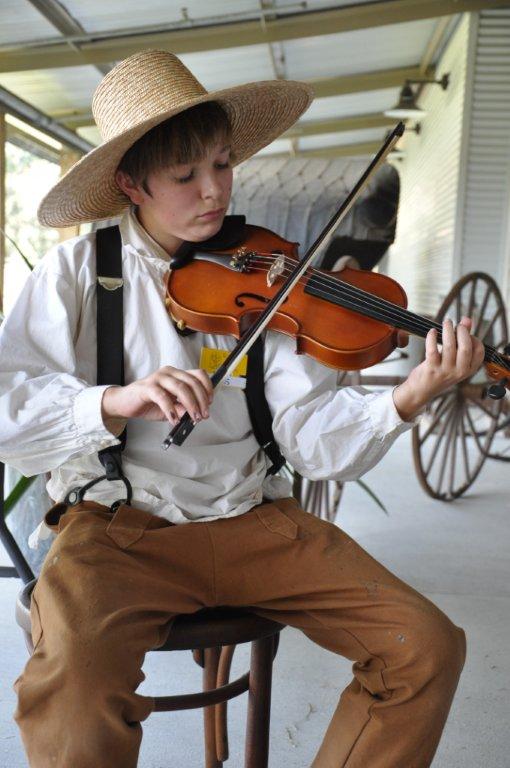
| 19th century violinist |
The journey through time began inside the exhibit barn, where you can find anything and everything from antique farm equipment to an old hearse to a baby walker. The normally quiet, static museum was a bustle of activity, with visitors mingling with docents, a woman carrying her pet duck puppet and wood carvers whittling away at small figures. We stopped to visit with one woman rhythmically pedaling a spinning wheel, turning balls of wool into a long, fine thread. She explained how wool is easier to spin than cotton, which requires a faster turn of the wheel because it is a slicker material.
.JPG) |
| Mule and buggy rides |
As you exited the back door, the village emerged, with sleeping tents set up throughout the property and small cooking fires smoldering in the day’s heat. Two mules pulled up in front of us, tugging behind them a buggy full of passengers, and 2-year-old August launched into a series of neighs. Our normally fearless children were actually timid around the animals, so we passed up the buggy tour and opted to walk instead.
“Homeowners” led us on guided tours through their 200-year-old houses, proudly pointing out the furniture and architecture of each. We watched the blacksmith stoke his fire until it was nice and hot, and the kids took turns pulling the rope on the steam engine to make the whistle blow. A harvest spread dominated the kitchen, where we encountered the delicious smells of pumpkins stuffed with baked apples and fried sweet potatoes.
.JPG) |
| Louisiana folk architecture at the museum |
The boom of a cannon was a constant background noise, reminding us that a Civil War reenactment was taking place across the field. We headed in the opposite direction, though, away from the “scary” noise and over toward the corn maze. Along the way, we stopped to smell some cane syrup being boiled and took a turn at grinding corn off the stalk.
An opening in the back fence led to the labyrinth of corn, where our 4-year-old pointed the way ahead. I have to admit, we finally cheated and charged right through the corn to get to the other side. Our reward was a handful of water balloons meant to be launched at wooden targets, but instead popped on top of the kids’ heads. Soaked through, they were delighted by the afternoon of fun and begged to return again.
.JPG) |
| The daunting corn maze |

by admin | Aug 21, 2012 | Greater New Orleans
The tiny town of Madisonville perched its stilted houses and businesses along the banks of the Tchefuncte River, which flows south and widens as it enters Lake Pontchartrain. Countless days of rain had prompted us to visit this historic maritime community, whose past has been interwoven with water since the earliest days of settlement around 1800.
 |
| Lake Pontchartrain Basin Maritime Museum |
We escaped the day’s remaining drizzle inside the Lake Pontchartrain Basin Maritime Museum, where a 3 p.m. arrival gave us an hour before closing to tour the exhibits. The kids were a whirlwind, as usual, absorbing every creature, boat and picture at lightning speed. My four-year-old had found three alligators, a squirrel and a bobcat before the rest of us even made it past the visitor’s desk.
A dimly lit wooden walkway set the scene for a ride on an early steamboat, and upon entering the boat, we emerged into a theater showing the history of the Tchefuncte River. From model boats and lighthouses to a replica Civil War submarine and river pilot boat, every inch of the museum was chock full of interesting artifacts and details about the state’s long and unique reliance on water.
 |
| Tchefuncte Lighthouse |
Also under the Maritime Museum’s management is the elegant, black and white Tchefuncte Lighthouse. Although accessible only by boat, a bumpy drive to the end of the road placed us in perfect viewing distance. Originally built in 1837, the lighthouse was nearly a casualty of the Civil War but was rebuilt shortly after and still flashes its light today.
From the bottommost tip of the road, we traveled north to the opposite end of town, snapping photos of the tranquil river and historic courthouse (now a museum) and branch library. The riverfront restaurants were hopping with the exiting church crowd, and we picked up some quick seafood-to-go at Morton’s.
 |
| Otis House at Fairview-Riverside State Park |
Next up was Fairview-Riverside State Park, where we ate in a covered picnic pavilion while gazing at the lovely 19th century Otis House (open for tours Wednesday through Sunday). We walked the perimeter of the house toward the ponds and river behind it. The rain-soaked ground squelched beneath out feet as tiny frogs jumped ahead of our every step. Needless to say, the bug catcher was put to good use, and we had a fantastic time chasing the amphibians until a snake slithered across my path.
That was our cue to move on, and we drove past the campsites to the boardwalk swamp and river trails. Our arrival was greeted by those strangely large “Devil’s Horses” (palm-sized, black grasshoppers) sitting motionless in the grass, on the trees and along the boardwalk. A game ensued of my two-year-old spotting the critters, pointing one tiny finger at them and yelling his brother’s name until his older sibling made his rounds and fearlessly plopped them in the bug catcher.
As we left with our car full of critters, we stopped for a final glimpse of the setting sun casting a reddish glow on the cypress trees lining the water.
 |
| Sunset over the Tchefuncte River at Fairview-Riverside State Park |
.JPG)
.JPG)
.JPG)
.JPG)
.JPG)
.JPG)
.JPG)
.JPG)
.JPG)

.JPG)
.JPG)
.JPG)
.JPG)
.JPG)
.JPG)
.JPG)