by admin | Apr 19, 2011 | Cajun Country
I’ll be the first to admit that I don’t know a blue jay from a bluebird, but experts and amateurs alike are welcome at the Grand Isle Migratory Bird Festival…at least that’s what my husband, Paul, told me while packing us up for a two-hour drive to Grand Isle. I was quite doubtful that our three-year-old would be welcome among groups of whispering, tip-toeing bird watchers, but I plugged in the portable DVD player and took out the map for the drive.
 |
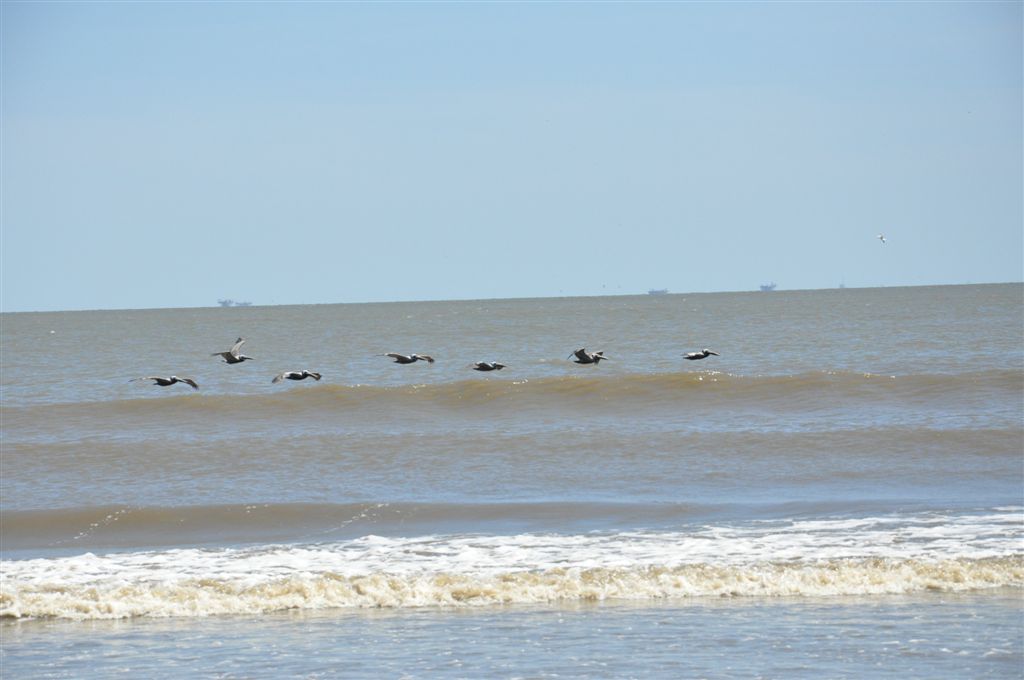
| Pelicans skimming the ocean. |
There are two important things to know before you even get to Grand Isle: going one mile too fast will earn you a speeding ticket in Golden Meadow and the new, white bridge leading to the island is a toll bridge with no toll booth. Once you conquer these two obstacles, you emerge on a decent-sized island known for its fishing, birding and, of course, proximity to oil.
We picked up some poboys at the elevated deli near the beginning of the island and carried them over to the beach for a picnic lunch. The wind whipped in our face, blowing sand and our napkins across the parking lot, but Charles was oblivious while he marched off with bucket and shovel in hand. The beach here is not the fine white sand you find in Florida, but rather crushed shells packed tight into a solid surface. We soon found out there are other perks, though, as a dolphin playfully danced through the ocean right in front of us while dozens of brown pelicans skimmed the surface of the water searching for food.
 |
| Charles on his first fishing trip |
Finishing off lunch, we drove to the far end of the island to Grand Isle State Park. The park was free for the birding festival, but the beach was closed due to large amounts of tar balls showing up at the water’s edge. As we walked the length of the fishing pier, we gazed longingly at the finer, silky sand that was off-limits to visitors. Several weekend vacationers were manning fishing poles at the end of the T-shaped pier, and in the 20 minutes we watched, they pulled in four catfish and an enormous sting ray. Charles even got to guard a fishing pole while one kid left to drop his latest catch in the ice chest.
 |
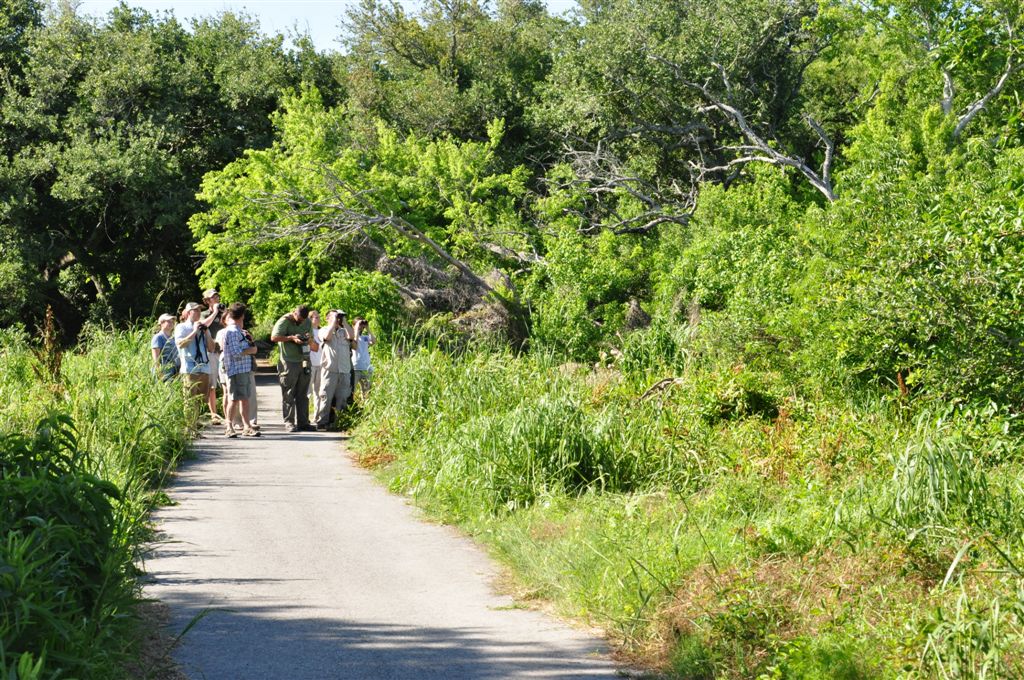
| Birdwatchers in the Grilleta Tract |
On to the birding festival, we parked our car at the Nature Conservancy trail head marking the entrance to the Grilleta Tract. One of the last remaining stands of maritime forest on the island, it’s a prime location for a phenomenon known as a “fallout.” When thousands of exhausted, migrating birds fly into a thunderstorm, they are forced to fall out of the sky and seek refuge in the island’s trees. Our arrival didn’t coincide with a storm, but we still saw hundreds of birds — and dozens of onlookers — along the trail. We were oblivious to what we were looking at, but made a good showing by hiding behind our camera and binoculars. We almost got away with it until a serious birdwatcher carrying an actual telescope asked us what we were taking photos of, and Paul answered, “the trees.”
 |
| View from the golf cart |
The trail ended at the backyard of Bobby Santini, who welcomed us onto his property to view his pictures of birds and taste the berries from his mulberry tree. This is where our second goof occurred when the “roosters” I pointed out to Charles went inside their coop to lay some eggs. At that point, I figured we could give up our act. Charles’ sudden interest in Mr. Bobby’s golf cart had him taking the toddler and Paul for a ride, while I sat on the porch swing with August, who flirted away with Mrs. Santini. It turned out the native Grand Islanders lived in a 213-year-old house — the oldest on the island — and it had survived both hurricanes Betsy and Katrina.
The golf ride revealed a great playground just a few streets away, and the kids and I stopped over to explore it while Paul went back for the car. Later, back on the main road searching for a dinner spot, we found a cute souvenir shop where Charles landed a pirate’s hat and Paul picked up some shells. The shop owner’s recommendation then led us to Sarah’s Restaurant where we pigged out on fried fish and potato salad, and Charles scared the other patrons with his rendition of a pirate. After a long day, I rewarded myself with a daiquiri for the ride home as we drove back out onto the thin road surrounded by endless wetlands on either side.

by admin | Apr 15, 2011 | Beyond the State, Mississippi
Heading east on I-10, a bathroom break for our finally potty-trained (yes!) 3-year-old turned into a destination at the Mississippi Welcome Center. The NASA shuttle stop first caught my attention, where buses were whisking families away to a tour of the nearby Stennis Space Center. Tugging August out of his carseat, I turned and caught a glimpse of the spider-shaped Lunar Lander hoisted in the air behind us. I just knew this was going to fascinate Charles as much as me, and I was giddy when I spun around to point it out to him.
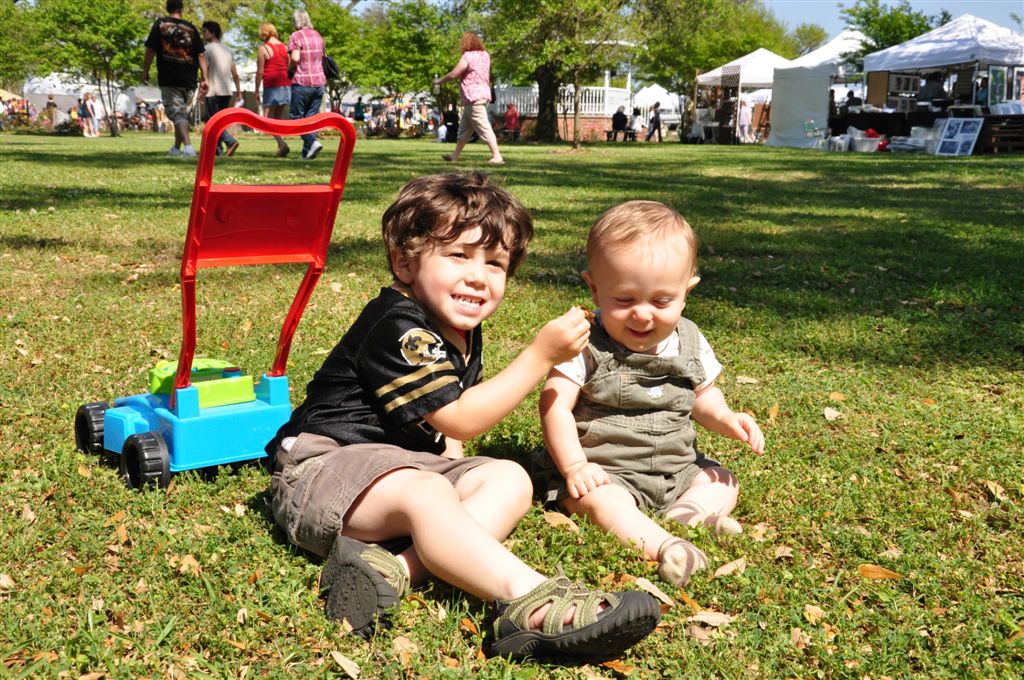
He was nowhere in sight, and I had a moment of panic until I heard a familiar clacking noise. There he was, halfway across the well-manicured lawn, pushing his bubble-blowing lawnmower his cousin had given him for his birthday. I couldn’t believe the attention he was getting. At least seven people shouted comments his way, most asking him to come mow their yard next. He was oblivious to his audience, fully intent on his mission at hand. I sighed as I jogged over to redirect him to the original reason we stopped, while my husband Paul went inside the main lobby to add to our extensive collection of travel brochures.
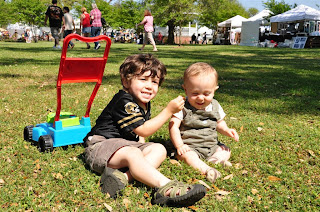 |
| Charles, August and the lawnmower |
Back outside, I managed to convince the family to cross the street and view the Apollo-era Lunar Lander, but I never seemed to garner the awe and amazement I was shooting for. That lawnmower was just too much competition. Oh, well. At least I was impressed.
Beyond the Welcome Center, we had traveled that day to Mississippi to visit Pass Christian, a coastal town that was having their annual “Art in the Pass” festival. Nestled up snug against the Gulf Coast, the town was hit hard by Hurricane Katrina and remnants of its damage could still be seen in the barren pillars marking the spots of past homes. But much of the town had returned, and the festival took place in a lovely park complete with a bandstand, playground and Marvin Miller’s oversized wooden sculptures carved into the remains of once mighty oak trees.
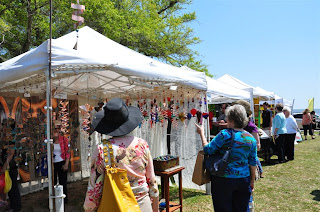 |
| Art booths at Art in the Pass |
Nearly 100 artists exhibited their works in booths, while local vendors offered up various options for lunch. We racked up in the children’s tent, leaving with a bag full of crayons, environmental coloring books and a stuffed sandhill crane. The event was typical of most other art festivals–except for the view. A quick run across Highway 90 and we were shoeless and walking across a sandy beach toward the water. It took the kids some time to get used to the squishy feeling between their toes, but soon Charles abandoned all reservations and was squealing with delight while chasing seagulls across the beach.
After a monumental effort to drag the kids back to the car, we headed off in search of coffee. Our quest led us along 90 over an impressive new bridge to Bay St. Louis. I was pleasantly surprised by the “downtown” area that ranked high on my list of best small towns. There wasn’t much time left in the day for a thorough investigation, but the drive by St. Stanislaus College Prep and our quick cruise up Main Street left me wondering why I had never been here before.

by admin | Apr 4, 2011 | Greater New Orleans
Journalist Chris Rose was on the news the other night expounding on how most people don’t play tourist in their own city. He, for example, had never been to the World War II Museum or Preservation Hall. While I had both of these covered, there were some places in New Orleans still left to discover. Take City Park. I have probably been there hundreds of times and, despite Charles’ wide-eyed, open-mouthed stare every time the pint-sized train tooted past us, I had never ridden with him on it. So today we were taking a concentrated section of the park and exploring its full potential.
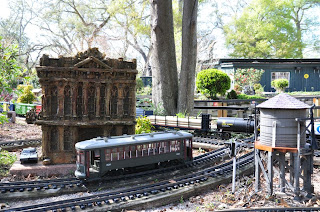 |
| Miniature train garden in the Botanical Garden |
We started off low-key with a leisurely stroll through the Botanical Garden. (A useful tip, buy a City Park membership, and enjoy free admission to the Botanical Garden, Storyland and the Amusement Park.) Built by the Works Project Administration (WPA), the Garden takes you on a winding journey past fish ponds, a rose garden, ancient live oaks, a butterfly garden, a Japanese tea garden and much more. Flowing sculptures by Enrique Alferez hold prominent spots among the vibrant flowers.
A favorite of my three-year-old was the tropical rainforest, where a surprise snake hides deep within the waterfall’s cavern. The only way we could lure him away was by tempting him with the hunt for lizards in the cactus garden. The final stop was the miniature train garden featuring small streetcars and trains chugging along amidst carved New Orleans homes and buildings. It’s the perfect place to build anticipation and excitement over the upcoming train ride.
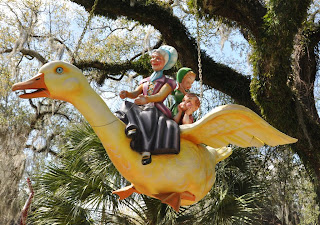 |
| Mother Goose takes flight in Storyland |
A short walk down the road past a giant Little Bo Peep and Humpty Dumpty lies the entrance to Storyland – a whimsical playground for young children. While Charles pretended to be Captain Hook battling Peter Pan on board the pirate ship, August came out of his usual Moby-wrap induced sleep and opened one eye to peer warily at the Big Bad Wolf hiding in Grandma’s House. From Pinocchio’s whale to the old lady who lived in a shoe, every childhood fairytale memory was vividly brought to life.
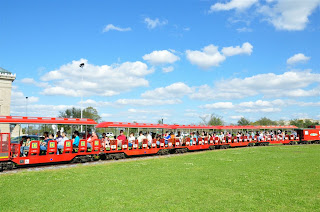 |
| City Park’s train |
Storyland’s back gate opens up into an amusement park complete with a roller coaster, twirling and spinning rides and country fair-style games. The lights and sounds were still scary to the eyes of a toddler, so we bypassed it all heading to the far side of the park. Only the carousel, exquisitely restored after Katrina, caused a slight pause in reaching our destination. But when we saw the crowd boarding the train, we ran to catch up and grabbed two seats near the very back.
With a blow of its whistle, the train pulled out onto the tracks, taking us on a sightseeing tour of the south side of the park. We waved at bystanders, pointed out the swans relaxing under a bridge and watched the streetcar clatter by on Carrollton Avenue. The duration was just perfect as attention spans were maxing out right as we pulled alongside the Botanical Gardens and soon slowed to a stop.
 |
| Irises blooming in the Sculpture Garden |
Breaking for a snack and juice, we enjoyed two minutes of relaxation before carrying on to one of my favorite places in City Park – the Sculpture Garden. Anything goes here in this artistic haven, from monkeys morphing into humans and an enormous spider with spindly legs to blue dogs and oversized Mardi Gras beads in trees. April is iris time in south Louisiana, and we were greeted with a rainbow of blooming irises gracing the edge of the water that cuts a path through the sculptures.
It was a packed morning and early afternoon, but for once, we made it home in time for a late lunch and Charles’ nap. Meanwhile, my daydreams of catching a few minutes of shut eye were dashed once I realized, after having slept through most of our day’s adventures, August was now rearing to go…

by admin | Mar 29, 2011 | Greater New Orleans, Most popular
Lured into St. Bernard Parish by a festival, we ended up staying late into the evening to see plantations, a battlefield and chickens. That’s right, chickens kept us out way past nap time. But I digress. It all started when I saw the newspaper article about the Los Islenos Festival. Having skipped it the last two years, I was determined to go. So we called a friend who lived in “The Parish,” as St. Bernardians call their beloved home, and made plans to meet up with her there.
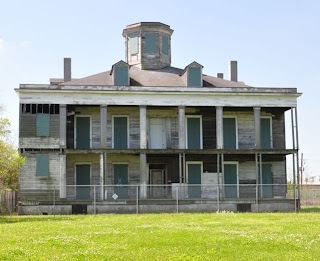 |
| LeBeau Plantation |
Driving along the back end of the French Quarter, past Bywater and the Lower Ninth Ward, we had a short pit stop to see two plantations that, although within walking distance of each other, are as different as night and day. LeBeau Plantation’s boarded up remains stand eerily proud behind a deep, grass field and a chain link fence. The new roof is in curious contrast to the gaping holes in the wall, but the home lends itself to being photographed. Meanwhile, on the property of the Domino Sugar Plant, the stately Cavaroc mansion appears well-loved in its pristine state. A word to the wise, though, snapping a picture of this beauty will earn you the disdain of the Domino Sugar guards, who descended upon our car, scrawling down our name and license plate number like we were suspected terrorists.
 |
| Chalmette Battlefield |
Fleeing the scene of the crime, we continued on to Chalmette Battlefield, which marks the site of the Battle of New Orleans where General Andrew Jackson and his ragtag group of American troops held off the British attack during the final struggle of the War of 1812. Beginning in the newly built visitor’s center, we pressed the button to start the video while I mentally calculated how long I had before having to take off in a chase after Charles. Amazingly, the moving lights of an accompanying diorama kept his attention, and for the first time in years, we were able to see an entire movie. In the end, I broke his attention and dragged him away to look at a large drum so he didn’t see the final results of the war graphically displayed across the screen.
Back outside, he proudly waved his miniature American flag while we led him toward the oddly small Beauregard Plantation, built on the property in 1840. After posing for family pictures in front of our pretend home, we explored the empty rooms inside. The temperature dropped remarkably when we stepped onto the marble floors and felt the cool breeze blowing across the open, facing doors in every room. August lazily watched Charles racing through the house, while I stopped the toddler in his tracks by pointing out a “secret” door to the attic. Little did I know that the door would become the primary topic of discussion for the rest of the day, leading to elaborate stories about a six-armed green monster locked away by the superhero Batman.
The plantation sits on the edge of the Mississippi River levee, and after a quick climb up the steps, we were delighted to catch a glimpse of the Creole Queen paddlewheeler floating by. Another top attraction at the site is the multitudes of crawfish chimneys lining the path to the cannons. Charles was fascinated with peering inside, desperately trying to see the crawfish at the bottom.
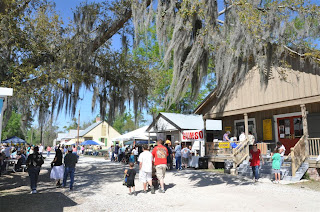 |
| Los Islenos Festival |
Now starving, we made a beeline down the San Bernardo Scenic Byway, passing under an avenue of live oak trees flanking the roadway, to the food booths at the Los Islenos Festival. Advertised as “A celebration of Louisiana’s Spanish Heritage,” the festival paid tribute to the Canary Islanders who settled in the region in the 1700s. Along with Spanish food, music and dancing, we found local craft booths and spacewalks scattered throughout the Los Islenos Historic Village. After refueling on paella and sangria, we explored the museum-quality homes and their endless contribution of “secret doors.”
We enjoyed a few moments of rest while listening to the large group of Spanish singers on stage before packing everyone up and heading home. One last detour was meant to be a quick in and out picture of the Sebastopol Plantation. Being a private residence, we were surprised to see a sign advertising free tours from noon to 4 p.m. Not only is it a rare event to stumble upon free entrance into a plantation, it is even more amazing that at 4:30 p.m., the owner and curator, Alberta Lewis, saw us stop our car and came to offer us a tour past closing time.
 |
| Sebastopol Plantation |
Charles, August and I made it almost through the history of the first room before having to go outside and spare the house from damage. While Paul was given a guided presentation of the 180-year-old house, the kids and I met a friend of the owner who engaged Charles in picking up pecans across the expansive yard. He then led us to the chicken coop, where roosters, chickens and two peacocks strutted all around our feet. We left carrying a basket of pecans, half a carton of fresh eggs and a lasting memory of the generosity of two St. Bernardians (one of whom also happened to be the talented artist behind Haydel’s king cake dolls).

by admin | Mar 14, 2011 | Greater New Orleans
Every Monday morning, thousands of people wake up at the crack of dawn to leave their homes and drive across the longest bridge in the world to their jobs in the city. A lover of sleep and a hater of traffic, I’ve always wondered what could possess someone to willingly choose that daily commute across Lake Pontchartrain. But as one coworker described it, there’s a certain point on the drive home when the New Orleans’ skyline fades away and so does all the stress that comes with it. St. Tammany Parish, also known as the Northshore, is home to quaint towns that pride themselves on not being a suburb of New Orleans. This weekend, we decided to see what it is about the Northshore that lures people across that 24-mile-long Causeway Bridge.
Getting a late start, we were already hungry for lunch before we reached the Interstate. So we rerouted our original plans, bypassing Mandeville and Covington and heading straight for Abita Springs and the Abita Brew Pub. Once the home to the actual brewery, now the restaurant serves up oversized portions of salads, hamburgers and other entrees along with a wide selection of Abita beer. Eating establishments are always touchy with two small kids, but the free crayons and coloring sheet went a long way toward keeping Charles in check until his shrimp and french fries arrived. Of course, he scarfed them down in 2.4 seconds and then bolted out of his chair in search of mischief. Luckily, I have learned to eat equally fast and was able to guide him out the door while my husband, Paul, paid.
 |
| Indian princess kneeling over the spring |
Abita Springs is tiny as far as towns go. It’s one of those places where if you blink while driving too fast, you’ll miss the downtown. You’ll be sorry if you do, though. Walking out the front door of the Brew Pub, we found ourselves standing on the Tammany Trace, a railroad track turned into a bike/jog/horseback ride path that runs across St. Tammany Parish. The Trace plunges you deep into nature and then opens up at each town or city it passes. Dodging the bicyclists, we crossed the trail and headed toward the large gazebo built in 1884 for the New Orleans World’s Fair. It was reconstructed over — what else — but the famous spring that once lured tourists with its clean waters. Today, a statue of an Indian princess kneels over the bubbling water.
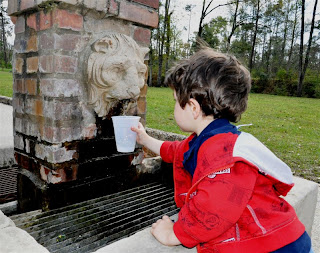 |
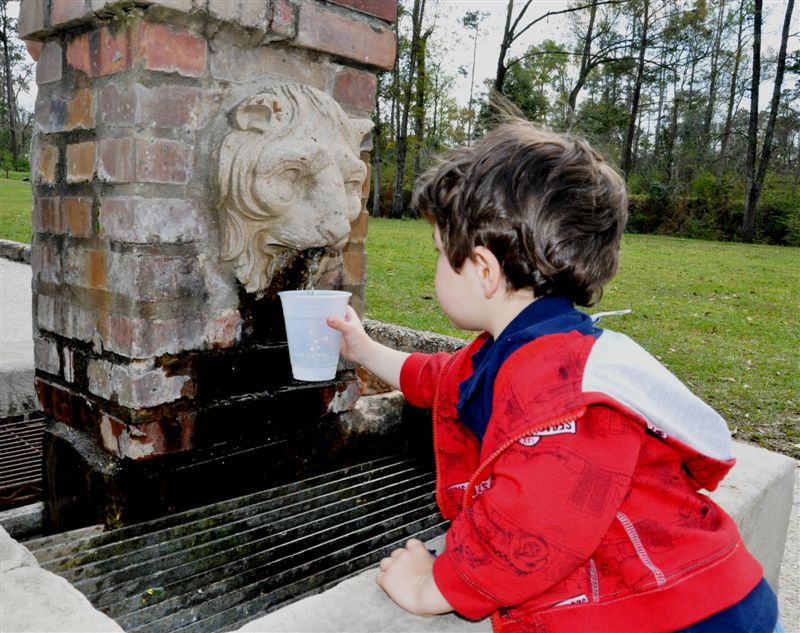
| Lion’s Head fountain pouring spring water |
As we walked toward the town museum, Charles spotted a man carrying an instrument and ran off to investigate. Within minutes, several more musicians arrived and started up their weekly concert. We admired the music until the museum guide revealed to Charles the secret for starting up the water park and then gave him a cup to collect water from the lion’s head fountain. He was so fascinated by drinking the water pouring out of the lion’s mouth that he never even noticed the playground looming large behind us.
Anxious to continue our journey, Paul steered us toward the car and the Nature Conservancy’s Abita Creek Flatwoods Preserve where a boardwalk runs through a long-leaf pine savanna and swamp. Unfortunately, the carnivorous yellow pitcher plants were not in season, but it was still a pleasant walk on a perfect, 70-degree day.
Back on the road, we headed south on 59 and stopped off at Tammany Trace Headquarters and the Kids Konnection playground. While I fed August his unappetizing jar of turkey and vegetable dinner, Paul and Charles went off to play in the sand pit. At the visitor center half a mile down the road, we picked up glossy brochures highlighting all the places we missed before continuing on to scenic Mandeville. A drive along the shores of Lake Pontchartrain tempted us to stop the car and take a stroll. Behind us, couples enjoyed romantic dinners in restaurants overlooking the sun setting on the massive lake.
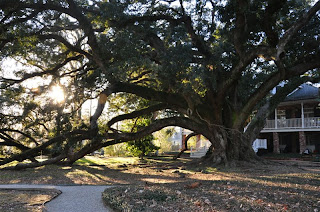 |
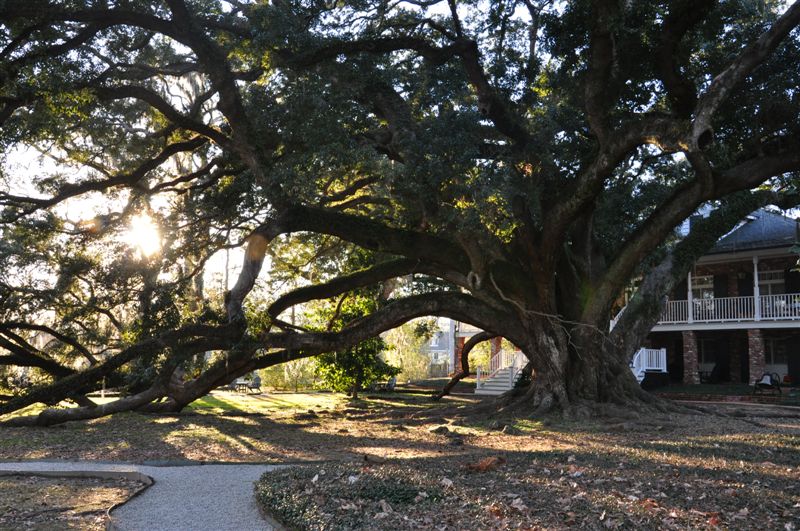
| Seven Sisters live oak tree |
There was only time for one last stop before making our way back across the bridge, and Paul led us deep into a neighborhood to find the Seven Sisters, the oldest live oak tree in Louisiana. He couldn’t hide his enthusiasm at finding the gem and had to sneak up the driveway of the private property to take this picture.
While the kids were lulled to sleep by the monotonous bumps of the bridge, I pulled out the brochures and made a quick wish list for the future. We had only touched the stem of St. Tammany Parish and had much to go back and see. So what’s on the list for next time? Well, for starters, there’s Fountainebleau State Park, Camp Salmen, the Global Wildlife Center, Saint Joseph Abbey, and on and on and on…